A staggering amount of historic urban fabric has disappeared from American cities, but to me, “Lost” doesn’t just mean bulldozed.
It can mean a transformation so complete that few people remember what came before.
Still-standing buildings can be lost to decades of neglect that stripped away much of what made them distinctive, and their ongoing preservation can turn into controversy.
Fascinating lost history can be hiding in plain sight, in the more ordinary buildings that are almost completely unknown to the people who walk by them every day.

I’m Andrew Walsh, a librarian and the author of Lost Dayton, Ohio.
I created Lost Urban Vistas to expand the work I’ve been doing on my website Dayton Vistas for nearly a decade, documenting history and urban redevelopment through articles, videos, a podcast, and live events like presentations and walking tours.
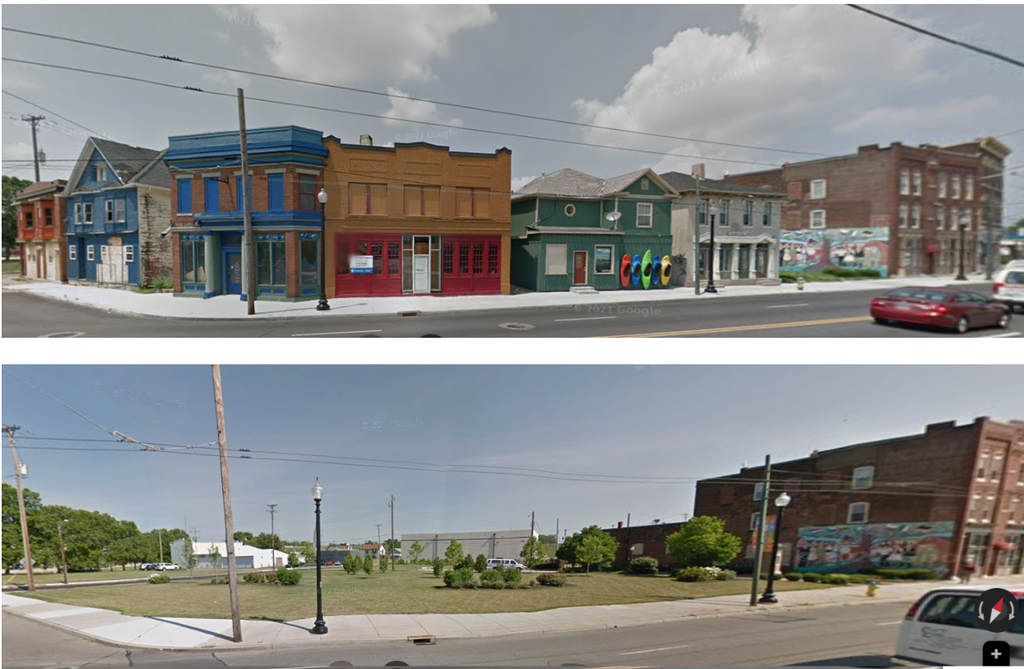
American cities were remade in the mid-20th century in ways we are still reckoning with today. Entire neighborhoods were cleared in the name of urban renewal. Highways plowed through the hearts of cohesive communities. These large-scale projects usually failed to deliver the future they promised.
Meanwhile, factories, theaters, and other forgotten buildings continued to be demolished for decades to make way for parking lots and office towers. In other cities, they deteriorated over time and eventually became vacant lots.
The consequences of these decisions are still impactful: in downtowns that feature isolated pockets of activity surrounded by surface lots, in the neighborhoods that never recovered.
But that’s only part of the story.
Lost Urban Vistas isn’t intended to be solely an exercise in nostalgia (or depression).
It’s also about what cities are doing today to reinvent themselves, and about the extraordinary efforts to preserve the streets, storefronts, and neighborhoods that still hold those stories.
The brewery converted to apartments. The train station saved by a grassroots campaign that refused to let it go. The small business owner who has remained in the same building for decades, while the surroundings have changed beyond recognition.
These are the found aspects of urban history: the places that survived, and the reasons why they matter, for what they say about the past as well as the present.

I love to cover adaptive reuse projects giving new life to old buildings; analyze the urban renewal era and its consequences; and highlight historic preservation debates including what factors led to redevelopment or demolition.
This can range from a manufacturing complex that shaped an entire region to a hidden historic gem that most people have never heard of.
My interest in urban history began in Dayton, Ohio so I have a particular interest in the industrial cities of the Midwest and Great Lakes.
I think cities like Cincinnati, Detroit, Cleveland, Pittsburgh, and Buffalo have some of the most compelling urban stories in America right now: factory empires that shaped regions, declines that are close to inconceivable, and now a wave of reinvention that most people outside these cities haven’t noticed yet.
But Lost Urban Vistas strives to highlight the past and present of cities all across America, from New York City to Los Angeles. In cities that are booming and in others that still have a long way to go.
Many articles feature my own photography taken on my visits to cities across the country, and the research draws on public archives, historic newspapers, Sanborn fire insurance maps, and local historical societies and public libraries across the country. I am also a voracious reader of American urban history and frequently weave those sources into my articles as well.
Overall, if you’ve ever stood in front of a surface parking lot and wondered what used to be there, this site is for you!