
Crosley Tower: A Brutalist Icon Coming Down at the University of Cincinnati
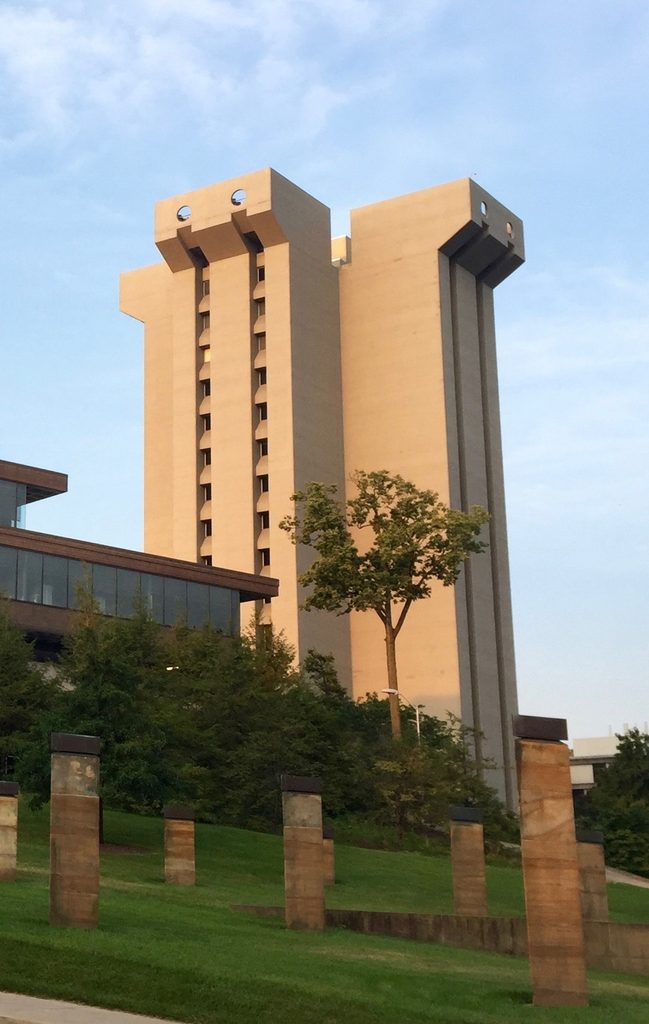
Architectural Digest once called Crosley Tower at the University of Cincinnati one of the ugliest university buildings in America. But generations of Cincinnati students loved it anyway, building replicas and forming a fan club in its honor.
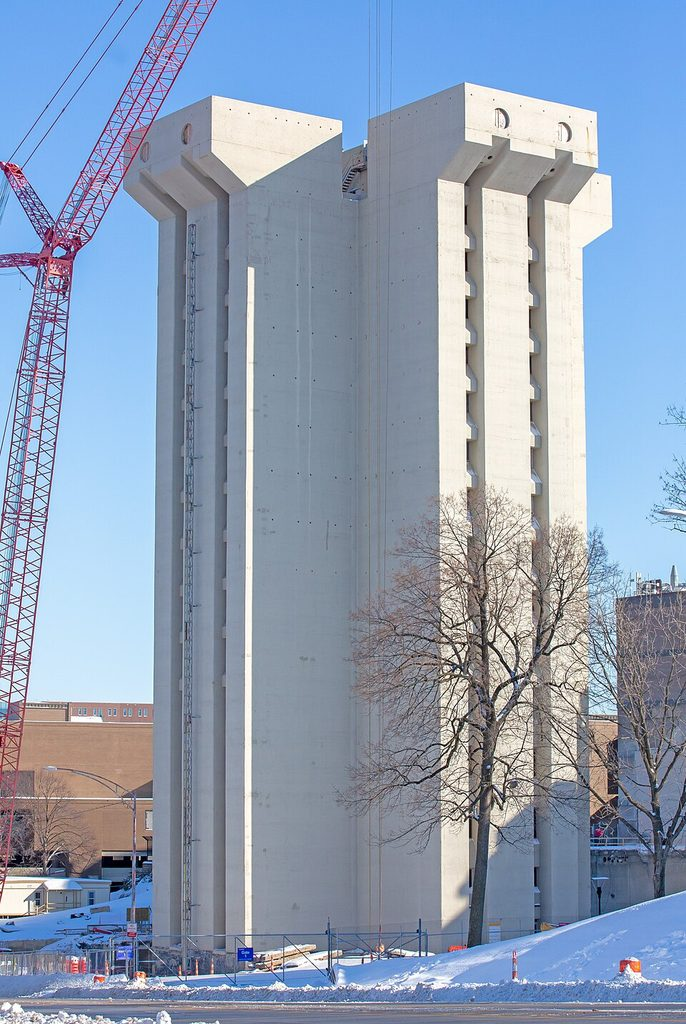
A record-setting feat of concrete construction, Crosley Tower is currently being demolished piece by piece.
Crosley Tower’s Origins
Crosley Tower’s name honors one of Cincinnati’s most influential businessmen, even though he did not have a direct connection to the building aside from being a UC alumnus.
That’s Powel Crosley Jr. (1888-1961), Cincinnati industrialist and inventor who founded the radio station WLW-AM, once the world’s most powerful transmitter, and also owned the Cincinnati Reds.
It was designed by architect Charles Burchard of Cincinnati firm A.M. Kinney Associates. Burchard had studied under Bauhaus founder Walter Gropius at Harvard and later went on to become the founding dean of Virginia Tech’s School of Architecture.
The Brutalist building was originally known as Building A2 in a larger science and engineering complex. Completed in 1969 at a cost of $5 million, Crosley Tower was built to house chemistry and biology labs and classrooms.
Brutalist buildings aren’t normally admired for the details of their construction, but Crosley Tower was a special case.
A Record-Setting Feat of Concrete Construction
The reason the tower is notable has much more to do with its structure and materials than its actual appearance.
Crosley Tower was built using the slip-form method, in which wet concrete was fed continuously into rising molds around the clock for 18 consecutive days without stopping.
This made it the largest continuously poured concrete building in the United States, and the second-largest structure of any type after only the Hoover Dam.
Because the pour could not be interrupted once started, the university negotiated no-strike clauses with its contractors prior to construction.
An enduring campus legend holds that a worker or even a Volkswagen fell into the wet concrete during the pour, although the university has denied both stories.
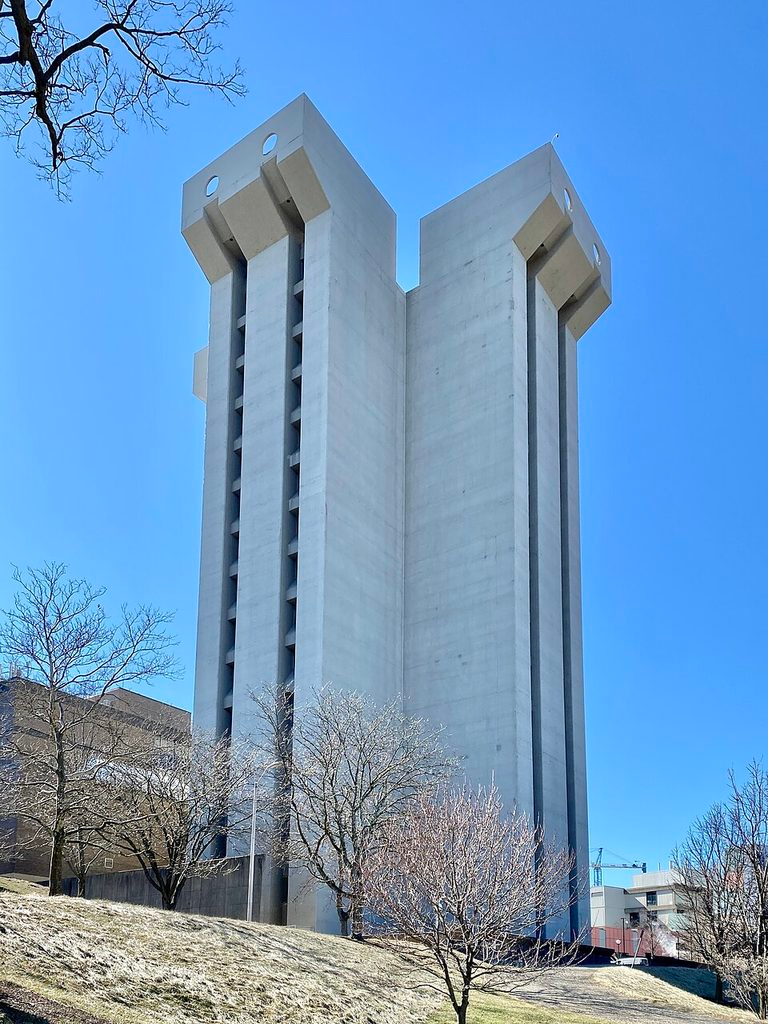
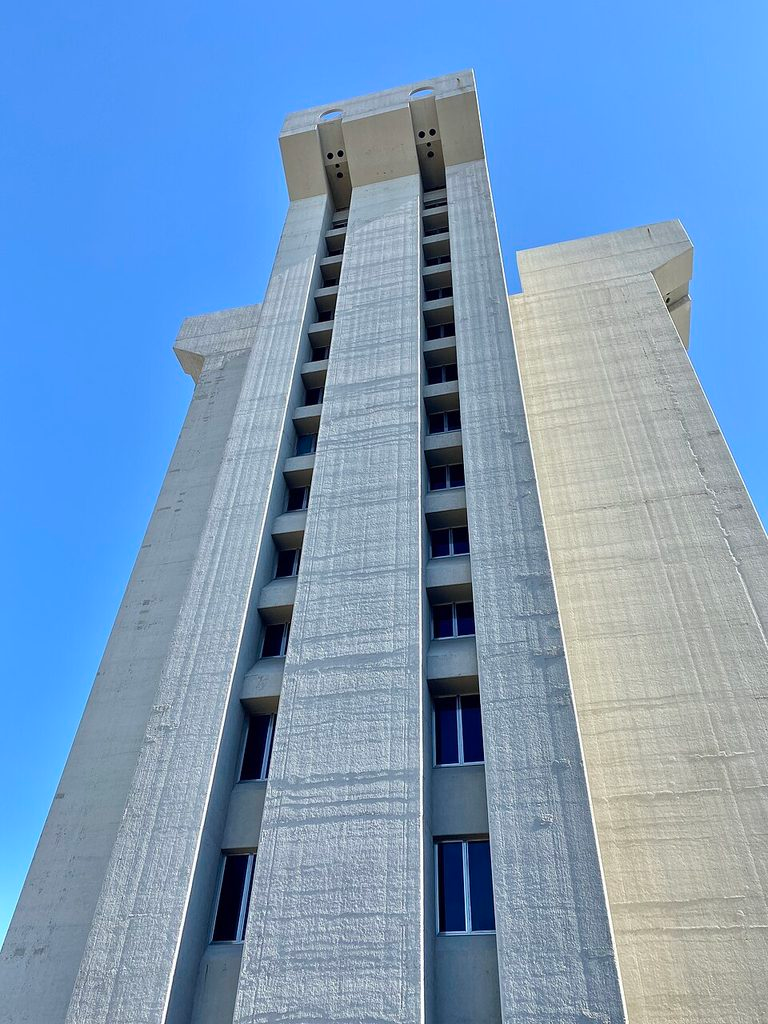
The building’s fluted, tapering form resembles an abstracted Corinthian column, with flared tops at each corner that served a functional purpose, venting fumes from the chemistry labs below.
Cincinnati’s Most Divisive Building
Few buildings on campus, or in Cincinnati overall, have inspired as much genuine disagreement as Crosley Tower. Its Brutalist design turned it into both a punchline and a beloved campus icon, sometimes at the same time.
In 2017, Architectural Digest ranked Crosley Tower among the seven ugliest university buildings in America, comparing it to an evil Disney villain’s lair.
Despite this, students formed a Crosley Tower Appreciation Club, built gingerbread replicas of the building that were even featured by the Wall Street Journal, and choreographed light shows set to music across its rows of windows.
In 2020, Cincinnati Magazine included the tower on a list of iconic architecture that defines the city.
But that appreciation would ultimately not be enough to save it after a long and well-documented decline.
Crosley Tower’s Demolition and What Comes Next
By 2018, the tower was already operating at only about half capacity, and university officials had settled on a 5 to 10 year timeframe for eventual demolition.
Aging concrete, a sinking foundation, and an outdated interior layout made the building unsuitable for renovation.
The University of Cincinnati Board of Trustees approved $47.3 million for demolition in 2025, and abatement work began that May.
Demolition began in January 2026, carried out floor by floor from the top down by Skanska and O’Rourke Wrecking Co., a deliberate process chosen because implosion was not a viable option.
It’s expected to be complete by early 2027, and a new 200,000-square-foot STEM Academic Facility is slated to open on the site by fall 2029.