
Larkin Administration Building: Frank Lloyd Wright’s Lost Commercial Masterpiece
In 1950, a wrecking crew spent six months tearing down a 5-story office building in Buffalo, New York.
The demolition took so long that the Buffalo Evening News remarked the building “was built to stand forever.”
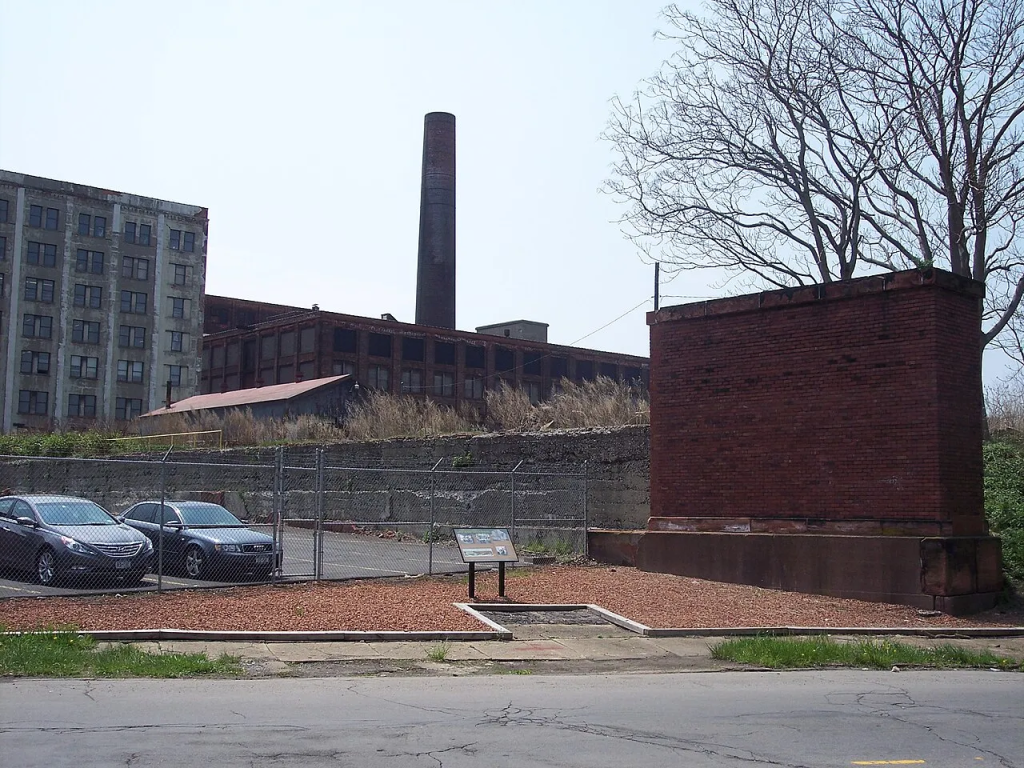
It was Frank Lloyd Wright’s first major commercial commission, and today, all that remains of it is a single brick pier standing along a railroad embankment.
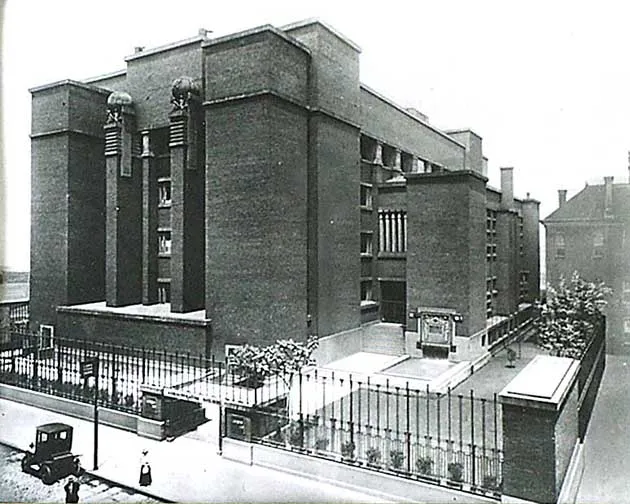
Frank Lloyd Wright’s Larkin Administration Building, Built 1904-1906
The Larkin Soap Company, founded in Buffalo in 1875 by John D. Larkin, had grown by the early 1900s into a national mail-order pioneer selling soap, groceries, dry goods, china, and furniture, with branches in Buffalo, New York City, and Chicago. Joining Larkin as the company’s principals were Elbert Hubbard, and Darwin D. Martin.
To consolidate its growing office operations, the company commissioned Frank Lloyd Wright, at the time a relatively unproven architect with no major commercial buildings to his name, to design a new administration building at 680 Seneca Street.
It was Wright’s first large commercial project, built between 1904 and 1906 at a cost of roughly $4 million, close to $96 million today.
The Larkin Building’s Innovations: Air Conditioning and Suspended Toilets
The five-story building, built of dark-red brick with pink-tinted mortar over a steel frame, was radical for its time in both form and function. Wright designed one of the country’s first fully air-conditioned office interiors, specifically to filter out the industrial soot common to Buffalo’s factory district.
He also designed built-in metal desk furniture, glass doors, radiant “gravity” heat, and suspended, wall-hung toilet partitions and bowls, a detail Wright later said he had invented simply because they were easier to clean underneath.
At the center of the building rose a 76-foot skylit atrium ringed with balconies, where roughly 1,500 clerks and typists worked in full view of the company’s executives on the main floor below.
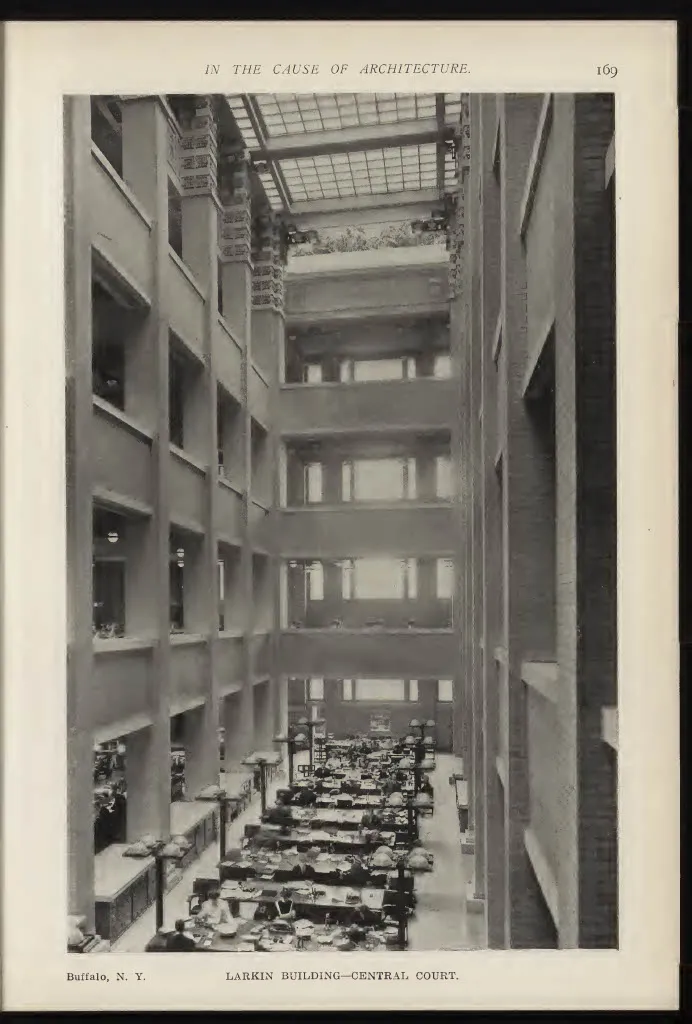
Fourteen sets of three-word inscriptions extolling the virtue of labor, phrases like generosity, altruism, and sacrifice, lined the courtyard’s piers. Sculptor Richard Bock contributed ornamental globes atop the building’s central exterior piers.
Wright himself later described the building as an expression of power applied directly to purpose, comparing it to an ocean liner or an airplane, though contemporary critics were less impressed. Architectural Record’s Russell Sturgis called it, at the time, a monster of awkwardness.
Why the Larkin Administration Building Was Demolished in 1950
The Larkin Company’s fortunes declined through the 1930s and 40s. Retail operations moved into the building in 1939 as the company tried to adapt, but by 1943 the firm was struggling to stay afloat, and the City of Buffalo foreclosed on the property for back taxes in 1945.
By 1947, the vacant building had already fallen into serious disrepair, with every window shattered, its entrance gate stolen, and roughly twenty tons of copper plumbing and roofing stripped out and sold. Children reportedly played among the ruins.
In 1949, the building was sold to a trucking company that intended to demolish it and build a warehouse in its place.
Architects and preservationists protested, but the demolition proceeded in 1950 regardless, an era when the concept of preserving twentieth-century buildings barely existed.
When word of the demolition reached Wright, he reportedly said the building had served its purpose and deserved a decent burial.
What Remains of the Larkin Building Today
The site became a parking lot. Today, a single brick pier still stands along the railroad embankment behind where the building once stood, and the sidewalks on Seneca Street carry granite markers tracing the footprint of the atrium, the entry, and the fence piers that once defined the building’s edges.
Wright scholar Jack Quinan has compared the building’s loss to losing one of Antoni Gaudi’s major works in Barcelona. Decades later, Buffalo preservationists still invoke the Larkin Building as a cautionary example whenever another significant twentieth-century structure faces the wrecking ball.
Related Reading:
For more significant Buffalo landmarks that faced their own stories of decline and battles between demolition and preservation, we’ve also written about the Buffalo Central Terminal.
Sources
Frank Lloyd Wright Foundation, “Larkin Company Administration Building”
Buffalo Spree, “WNY’s All Time Greatest Building We’ve Lost: Larkin Administration”
WNY History, “Demolition! The Larkin Administrative Building”
Buffalo AKG Art Museum, “Historypin: Larkin Administration Building”