Lost Victorian Streetscape: How Denver Erased Its 19th Century Commercial Districts
By the 1880s, Denver’s 17th Street had established itself as the financial center of the region, earning it the nickname of the Wall Street of the Rockies.
Major banking institutions, brokerage firms, and law firms lined the corridor, and the multi-story commercial buildings that housed them gave the street a dense, canyon-like character that was deliberately reminiscent of lower Manhattan.
It was one of the most commercially significant streets between Chicago and San Francisco.
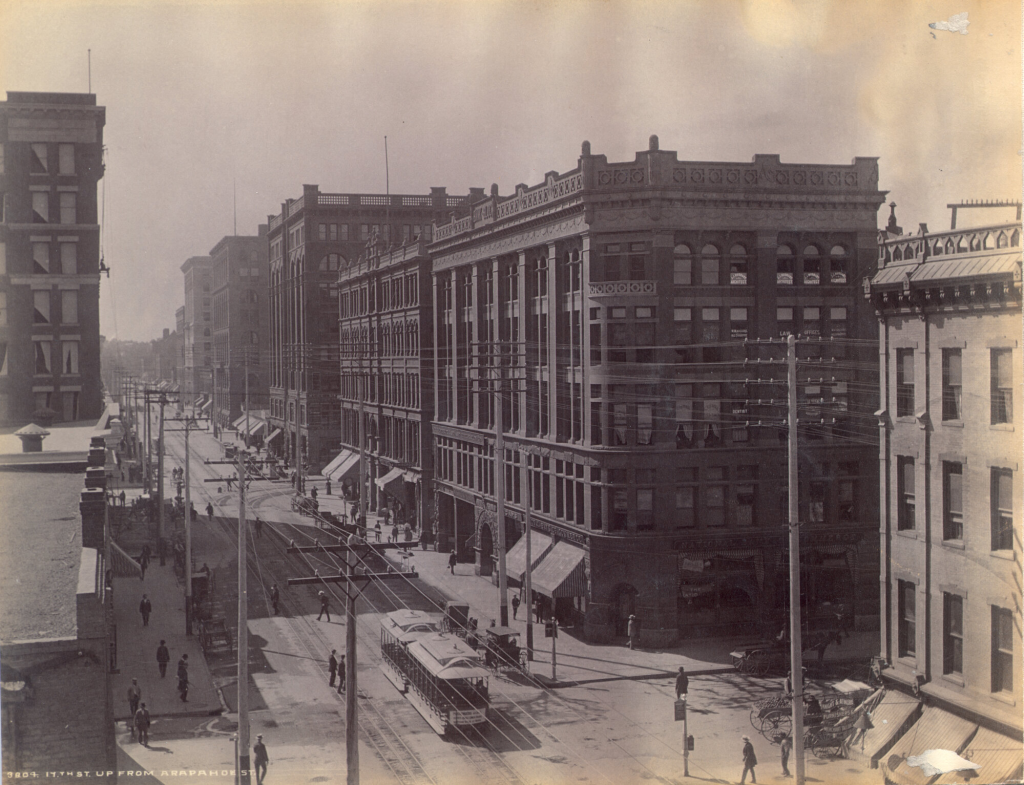
A photograph taken by William Henry Jackson sometime between 1882 and 1900 shows the corner of 17th Street and Arapahoe as it looked during the height of that era.
The street is still unpaved, horse-drawn wagons share the road with pedestrians, and a streetcar makes its way up the block. On either side, multi-story Victorian commercial buildings line the corridor, their facades detailed with the ornamentation that was standard for quality commercial construction of the period.
A sign on one building advertises “Knight and Atmore, Furnishers and Merchant Tailors.” The Denver Public Library record for the photograph notes a prominent bank building in the frame.
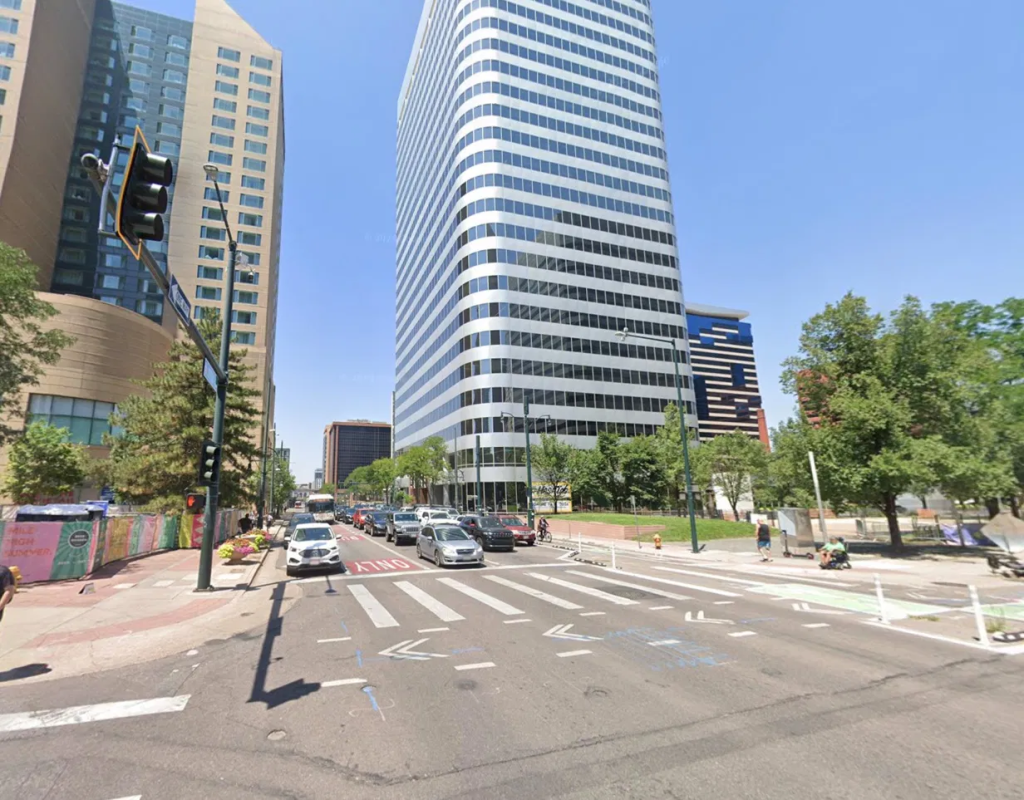
None of those buildings remain.
The Victorian commercial fabric at this intersection was cleared in the postwar decades as Denver, like most American cities of its size, demolished large portions of its 19th century downtown in favor of mid-century office towers and, later, modern high-rises.
Denver’s landmark preservation ordinance wasn’t enacted until 1967, and much of what Jackson photographed was already gone by then.
The Skyline Urban Renewal Project, launched by the Denver Urban Renewal Authority in 1964, accelerated the process further, targeting roughly 27 blocks of lower downtown for clearance in the name of modernization.
The buildings that lined 17th Street near Arapahoe were among the casualties.
But 17th Street was not completely erased. A few blocks up the corridor, two significant survivors of the late Victorian and early 20th century banking era remain standing, both now serving entirely different purposes.
The former First National Bank Building at 818 17th Street, completed in 1911 and designed by architect Harry Edbrooke, is now the Magnolia Hotel, listed on the National Register of Historic Places.
A few blocks away, the Colorado National Bank building at 918 17th Street, completed in 1915 and designed by Fisher and Fisher in Colorado Yule marble, is now the Renaissance Denver Downtown Hotel.
Its grand lobby retains a series of murals titled “Indian Memories,” painted by Colorado artist Allen True in 1925.
But unfortunately, the buildings Jackson photographed here did not survive long enough to be similarly repurposed.
Sources:
- William Henry Jackson, “17th St. up from Arapahoe St.,” 1882–1900, Denver Public Library Digital Collections, WHJ-1032
- “Wall Street of the Rockies” historical marker, 17th Street at Glenarm Place — https://www.hmdb.org/m.asp?m=135513
- Colorado Encyclopedia, “Wall Street of the Rockies” — https://coloradoencyclopedia.org/taxonomy/term/4702/all
- Colorado National Bank / Renaissance Denver Hotel, Denver Urban Renewal Authority — https://renewdenver.org/projects/colorado-national-bank/
- First National Bank Building, National Register of Historic Places / Wikipedia — https://en.wikipedia.org/wiki/First_National_Bank_Building_(Denver,_Colorado)