Pocahontas Building: Richmond’s 1923 Bank Tower Demolished for a New Courthouse
In downtown Richmond, a 14-story tower built in 1923 that once anchored one of Virginia’s largest banks is being torn down to make way for a new courts building.
The Pocahontas Building has stood at 900 East Main Street for more than a century, but as of August 2026, its demolition is in progress despite opposition by a coalition of local organizations.
History and Architecture of the Pocahontas Building: State Planters Bank Origins
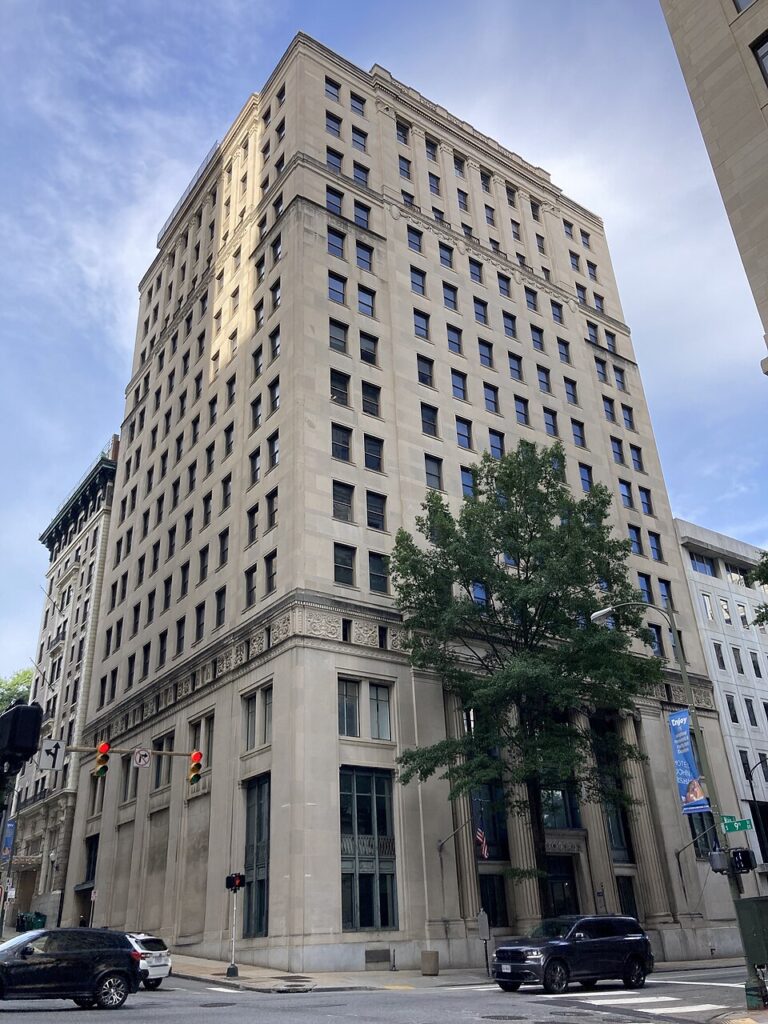
The older portion of the building is the West Tower which opened in 1923.
The 14-story, Beaux Arts-style structure was designed by Clinton and Russell, a New York firm that had already built a major reputation for early steel-frame high-rise construction. They brought their signature style to Virginia, and also designed three other buildings in Richmond’s growing financial center in the early 20th century.
The structure is a contributing building to the Main Street Banking Historic District, whose National Register of Historic Places nomination form describes some of its architectural features, including an “articulated entrance with colossal fluted Ionic columns that support a full entablature” and “an elaborate stone-carved frieze with urns and floral motifs on either side of the entablature above the third story.”
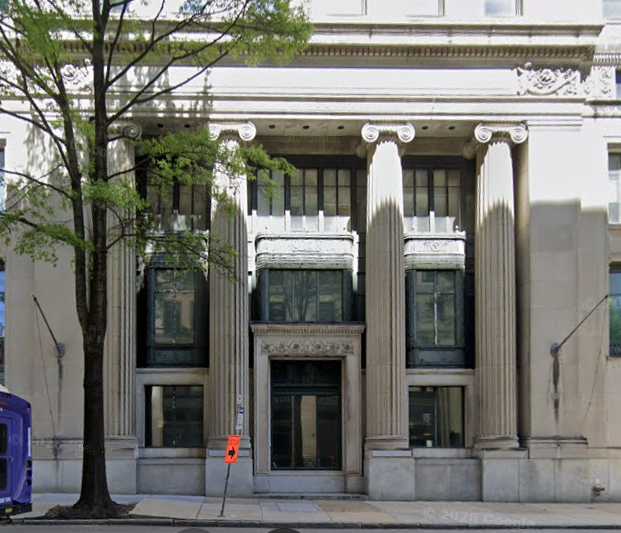
The structure was known initially as the State & City Bank & Trust Company Bank Building, then a few years after construction became known as the State Planters Bank.
State Planters Bank traced its roots back to Planters National Bank, an early Richmond banking institution that merged and reorganized in the early 20th century as the city’s financial sector consolidated.
The 1962 East Tower Addition
By the early 1960s, the bank’s operations had outgrown the original tower, and an 8-story East Tower addition was built in 1962, designed by the Richmond firm of Lee, King and Poole.
The two towers together came to be known as the Pocahontas Building, a name that stuck even as the bank itself changed hands and identities over the following decades, eventually becoming part of United Virginia Bank.
Housing Virginia’s General Assembly
The building’s later life took a different turn when it briefly served a governmental purpose.
While the Virginia General Assembly Building underwent its own construction and renovation, the Pocahontas Building was pressed into service as a temporary office space for state legislators from 2017-2023.
And soon after, another government plan would eventually lead to its demolition.
Why the Pocahontas Building Is Being Demolished
The Commonwealth of Virginia moved forward with plans to build a new $400 million Commonwealth Courts Building on the site intended to house the Supreme Court of Virginia and the Court of Appeals.
The demolition of the east tower addition was approved in 2023, and originally a rehabilitated west tower would have been part of the development.
But the following year, 2024, the State Art and Architectural Review Board (AARB) approved demolishing the west tower as well and completely clearing the site for the new 13-story courts building.
A spokesperson for the state’s Department of General Services said that “numerous structural and efficiency issues with the building were discovered during the design process last fall” including “existing floors being unable to support modern mechanical, electrical, plumbing and fire protection systems” and “story heights that would have required special accommodations to connect the existing building with a new courts complex” (Richmond BizSense).
Historic Richmond, Preservation Virginia, and the Partnership for Smarter Growth jointly opposed the demolition, arguing for the building’s architectural and historical value, but the state moved forward with its plans regardless.
They wrote that “The limestone façade, with its lavishly carved Ionic colonnade with cast iron screen is impressive and contrasts handsomely with the Mutual Building and First & Merchants Bank Building on opposite corners of 9th and Main Streets.”
As the towers come down, they erase one of downtown Richmond’s taller and more distinctive early commercial buildings, and a key part of its historic financial district.
Sources:
- Main Street Banking Historic District, National Register of Historic Places Nomination Form
- Historic Richmond, “Pocahontas Building,” https://historicrichmond.com/pocahontas-building/
- SAH Archipedia, “Pocahontas Building”
- Richmond BizSense, “State board votes to raze 12-story portion of downtown’s Pocahontas Building for new courts complex,” https://richmondbizsense.com/2024/07/15/state-board-votes-to-raze-12-story-portion-of-downtowns-pocahontas-building-for-new-courts-complex/
- Richmond BizSense, “Designs unveiled for new $400M state government office building downtown,” https://richmondbizsense.com/2025/02/19/designs-unveiled-for-new-400m-state-government-office-building-downtown/
- Richmond BizSense, “Architectural board OK’s new state courthouse building planned in downtown Richmond,” https://richmondbizsense.com/2025/06/09/architectural-board-oks-new-state-courthouse-building-planned-in-downtown-richmond/