Bromo Seltzer Tower: The Baltimore Skycraper Once Topped by a Giant Rotating Bottle
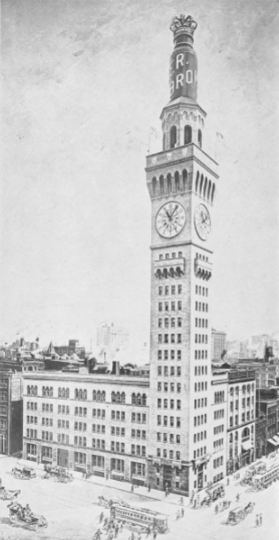
Isaac Emerson made his fortune selling a fizzy cure for hangovers and late nights. In 1911, he built the tallest building in Baltimore to advertise it, topped with a giant illuminated bottle that rotated over downtown for twenty-five years.
The bottle, once used by ship captains navigating into Baltimore’s harbor, was removed, but the tower remained. Much later it fell vacant but was successfully converted to artist studios, with several projects undertaken to restore key elements of the building’s original vision, including its clock.
Isaac Emerson and the Origins of Bromo-Seltzer and the Emerson Drug Company
Isaac Emerson was a chemist and pharmacist who ran three Baltimore drugstores before formulating Bromo-Seltzer as a headache and hangover remedy.
He reportedly named his medicine after Mount Bromo, an active volcano in Java, saying that its fizzing was reminiscent of the product.
Emerson trademarked Bromo-Seltzer in 1889 and organized the Emerson Drug Company shortly after with partner John F. Waggaman. Bromo-Seltzer was wildly popular, and Emerson’s successes would make him one of Baltimore’s richest men.
A Tower Designed for Florence’s Palazzo Vecchio, Baltimore’s Tallest from 1911 to 1923
On a European tour in 1900, Emerson marveled at the Plazzo Vecchio in Florence, and wished to emulate it back home in Baltimore.
His tower on S. Eutaw Street was designed by Baltimore architect Joseph Evans Sperry and built from 1907–1911. Its style is considered to be Romanesque, with yellow brick and stone trim. It has also been called the Emerson Tower.
The tower rose as part of a larger Emerson Drug Company headquarters and manufacturing complex built around it, with the tower serving as the complex’s signature architectural feature.
The tower’s four-dial clock, installed by the Seth Thomas Clock Company, spelled out B-R-O-M-O-S-E-L-T-Z-E-R instead of using numbers. It was said to be the largest gravity-driven, non-chiming clock in the world, and gives the tower a castle-like quality.
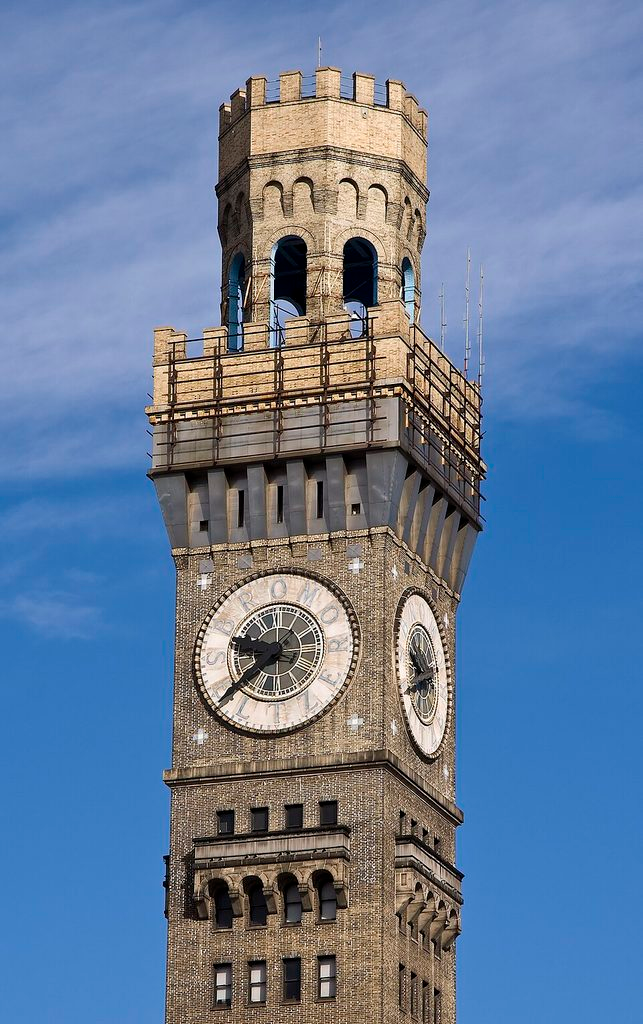
The 15-story, 289-foot early skyscraper was Baltimore’s tallest building from 1911 until 1923, when it was surpassed by the Citizens National Bank building.
Due to its height, the tower was an effective form of advertising for Emerson’s wares, visible across the city and the harbor.
The Rotating Bromo-Seltzer Bottle: A Baltimore Landmark for a Quarter Century
The tower’s most famous feature, however, was what sat on top of it: a 51-foot, 20-ton rotating blue steel bottle lit by 314 incandescent bulbs.
The bottle was visible up to 20 miles away on a clear night, and local accounts say ship captains used the illuminated bottle to navigate toward the Light Street docks.
But structural concerns ended one of Baltimore’s strangest skyline features twenty-five years. The bottle’s vibrations were found to have caused cracks in the tower’s structure, so it was removed in 1936.
Emerson himself did not see the removal, as he had passed away five years earlier in 1931.
Factory Closure and Vacancy
Isaac Emerson’s company was sold to Warner-Lambert Pharmaceutical in 1956, ending independent Emerson Drug Company operations at the site.
Warner-Lambert moved Bromo-Seltzer manufacturing out of Baltimore to Lancaster, Pennsylvania, in 1967.
The factory complex around the tower was demolished in 1969; Baltimore’s Fire Department later built the John Steadman Memorial Station on the site, opening in 1973.
The tower, of course, remained, and it was added to the National Register of Historic Places in 1973.
But by the early 2000s, it was largely empty and “virtually abandoned.”
The Bromo Seltzer Arts Tower Today
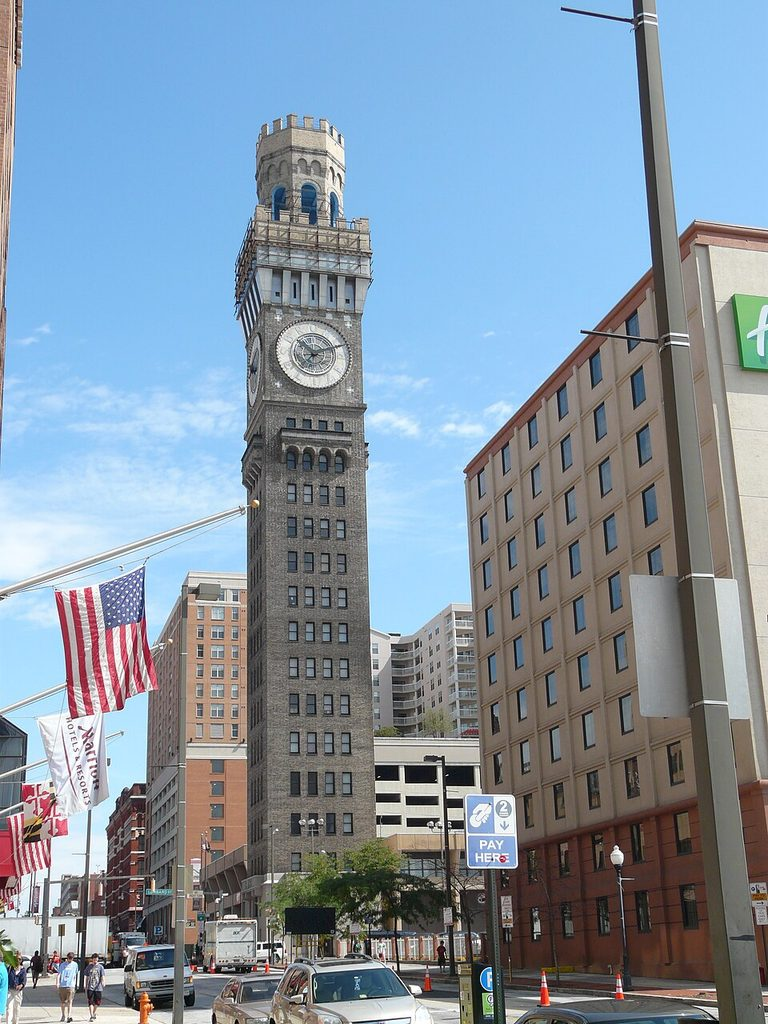
In 2007, the Baltimore Office of Promotion and the Arts, aided by philanthropists Eddie and Sylvia Brown, began converting the tower into artist studios which opened the following year.
The studios are aimed at both visual and literary artists and are open to the public on the second weekend of every month. The Bromo Seltzer History Museum also opened on the first floor in 2015.
The tower’s original Seth Thomas clock mechanism was fully restored to its gravity-driven design in 2017, at a cost of roughly $1.9 million. It had been running on electricity for decades.
A 2022 inspection found the tower’s facade deteriorating, and in January 2025 Baltimore requested $1.2 million in capital funding to restore it.
LB Building Science was awarded the contract in Spring 2026, with work focused on stabilizing the tower’s masonry and terra cotta exterior.
Sources
UMB Health Sciences and Human Services Library — https://www2.hshsl.umaryland.edu/hslupdates/?p=6652
The Baltimore Museum of Industry — https://www.thebmi.org/exhibits/bromo-seltzer-tower/
Explore Baltimore Heritage — https://explore.baltimoreheritage.org/items/show/82
Bromo Seltzer Arts Tower (official site) — https://www.bromoseltzertower.com/, https://www.bromoseltzertower.com/about
The Baltimore Sun — https://www.baltimoresun.com/1994/09/13/the-man-behind-bromo-seltzers-fizz/, https://www.baltimoresun.com/2011/06/02/bromo-seltzer-tower-celebrates-100-years-2/, https://www.baltimoresun.com/2004/10/02/john-steadman-firemans-fireman/
Peachridge Glass (Cecil Munsey, “Bromo-Seltzer,” 1992) — https://www.peachridgeglass.com/wp-content/uploads/2011/04/Bromo-Seltzer.pdf
Society for Historical Archaeology — https://sha.org/bottle/pdffiles/Bromo-Seltzer.pdf
David J. Goodwin — https://davidjgoodwin.com/2019/08/27/bromo-seltzer-baltimore/
Visit Baltimore — https://baltimore.org/neighborhoods/a-tour-of-bromo-tower-arts-entertainment-district/
CBS Baltimore — https://www.cbsnews.com/baltimore/news/charm-city-icon-bromo-seltzer-arts-tower-gets-makeover/, http://baltimore.cbslocal.com/2017/04/24/bromo-selzer-tower-repairs/
The Baltimore Banner — https://www.thebanner.com/politics-power/local-government/bromo-seltzer-tower-repairs-bopa-2QAQDUP6ORBETAQGBZPRQO3R4Y/
Lerch Bates — https://www.lerchbates.com/news/project-highlight-lb-building-science-awarded-iconic-bromo-seltzer-tower-rehab-in-baltimore/
Maryland Historical Trust (NRHP nomination form) — https://apps.mht.maryland.gov/medusa/PDF/NR_PDFs/NR-171.pdf
SAH Archipedia — https://sah-archipedia.org/buildings/MD-01-BC38
Dorsey, John & Dilts, James D., “A Guide to Baltimore Architecture” (1997), Tidewater Publishers