Scollay Square, Boston: From Old Howard Burlesque to Brutalist City Hall
Boston City Hall stands on the site of Scollay Square, formerly a crowded commercial district that came to be filled with burlesque theaters, taverns, and tattoo parlors.
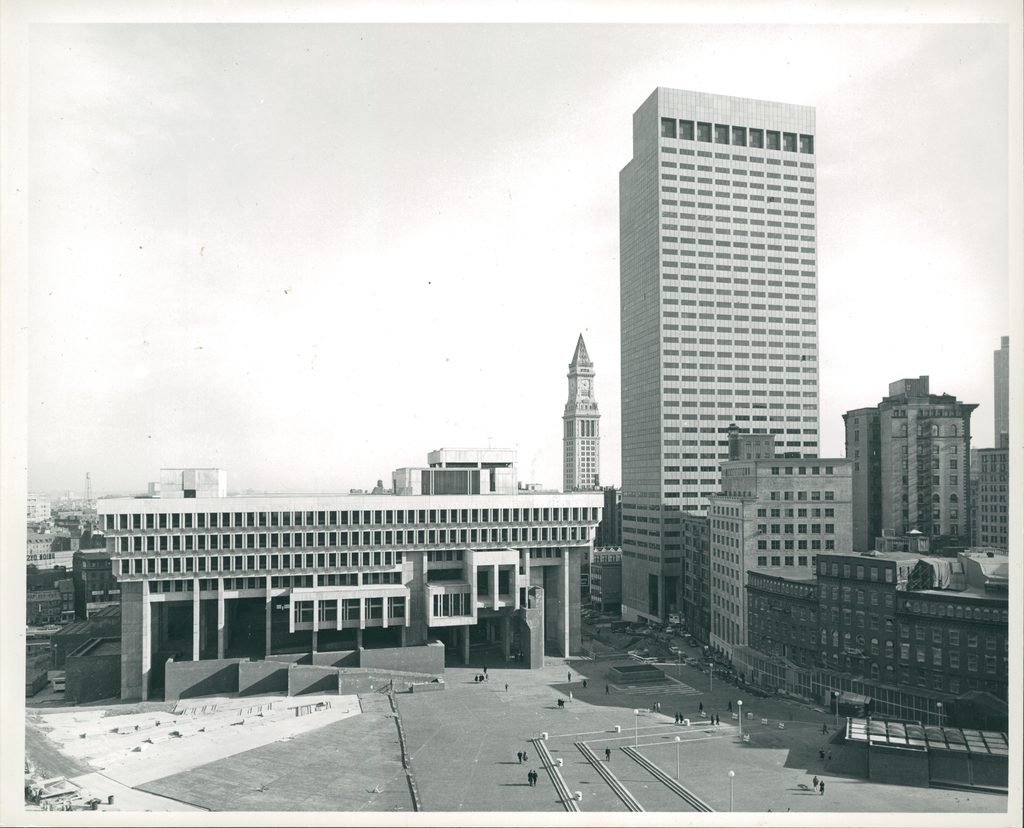
Two buildings mark opposite ends of Scollay Square’s story. The Old Howard, a burlesque theater, was demolished in 1962. Boston City Hall, a Brutalist landmark, was completed in 1968 on the site of the former square.
The old square did leave a few traces, and one of them is a subway sign.
Scollay Square in Boston: From Residential Streets to Entertainment District
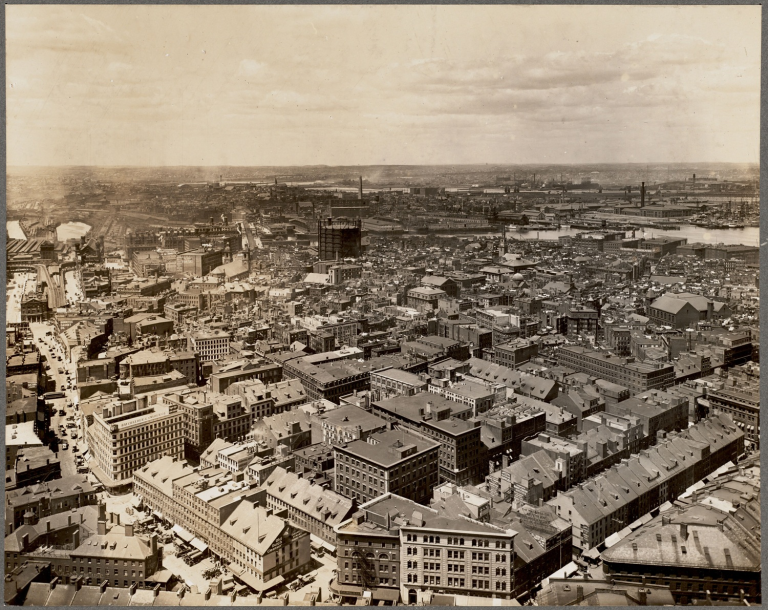
The square that would eventually be cleared had already changed quite a bit over the previous century.
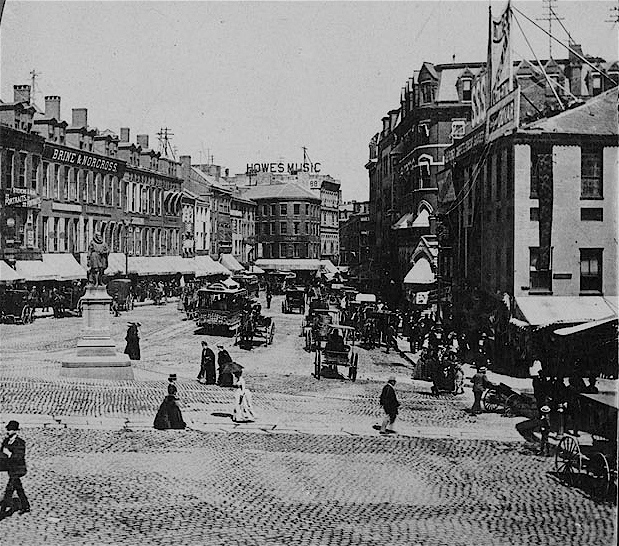
It had been an upper-class residential area since the 1830s bordering the old West End neighborhood. It developed into more of a commercial district as Boston grew in the subsequent decades.
From the mid-19th century until the decade after World War II, it had become Boston’s entertainment center, with its buildings housing burlesque and comedy shows, bars, tattoo parlors and penny arcades. Marquees promised “Continuous Performance,” and the sign at the Rialto Theatre read “Open all Night.”
The district attracted Bostonians of multiple social classes and was also a major destination for out-of-town sailors, especially during World War II.
The Old Howard and Ann Corio: Scollay Square’s Burlesque Theater
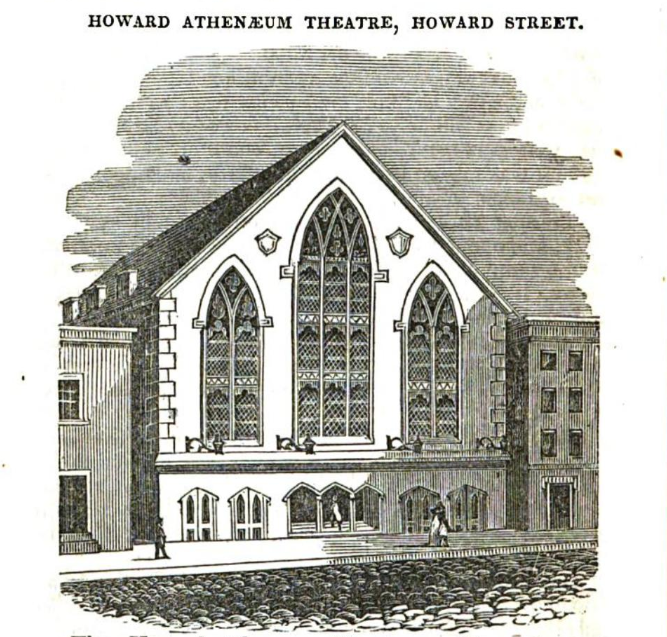
One building did more to would largely come to define the square’s reputation, but its start had nothing to do with the stage.
It was first built in 1843 as a church for the Millerites, a Christian millennialist sect that expected the world to end imminently. The sect disbanded after their prediction failed to come true, and the building reopened in 1845 as a theater called the Howard Athenaeum. It later became known as the Old Howard.
Its early programming was upscale, including Italian grand opera, the first American ballet performance of Giselle, and Shakespeare. As wealthy residents moved to the South End and Back Bay and Irish immigrants settled in, ticket prices fell and the bill shifted to minstrel shows and pantomime, then to special acts such as John L. Sullivan’s boxing matches.
Burlesque and striptease became the main acts in the 1920s, including a midnight Ladies’ Show that admitted women without escorts.
It launched performers including Abbott and Costello, Phil Silvers and Milton Berle.
Ann Corio was its best-known burlesque star from the 1930s-1950s.
Why Boston Demolished Scollay Square for Government Center
Overall, the square’s businesses had been struggling for years, and the plan for it would eventually follow the template already applied to the neighboring West End.
By 1957 the square’s combined real estate value had fallen by a third from Depression-era levels.
The administration of Mayor John Hynes and the Boston Redevelopment Authority, the city’s urban renewal agency, planned the redevelopment using federal money from the 1949 Housing Act.
The Old Howard burned on June 20, 1961, and Scollay Square was demolished the following year.
The area became Government Center, including City Hall, Center Plaza and the JFK Federal Building.
Boston City Hall: Brutalist Architecture on the Former Scollay Square
Two very different architectural eras now share the same plaza.
The Boston Landmarks Commission’s study report says it spared only the Sears Crescent Building, and that “the loss of 1,500 structures was a terrible blow” to downtown Boston’s historic fabric.
The Sears Crescent, a curved row of buildings at 38–68 Cornhill, is listed on the National Register of Historic Places along with the neighboring Sears’ Block at 70–72 Cornhill. The listing notes significance in 1816 and 1848 and Federal and Italianate styles.
The Government Center master plan was conceived in 1961 to replace Scollay Square. It called for a “medium-density center of civic activity” that would employ 25,000 white-collar workers.
The Boston Redevelopment Authority, the city’s urban renewal agency, announced a nationwide, two-round design competition for City Hall in 1961. A jury of Boston architects and business leaders unanimously chose the winning entry, by Kallmann McKinnell and Knowles.
Construction began in 1963, and the building was completed in November 1968. It opened to the public in early 1969.
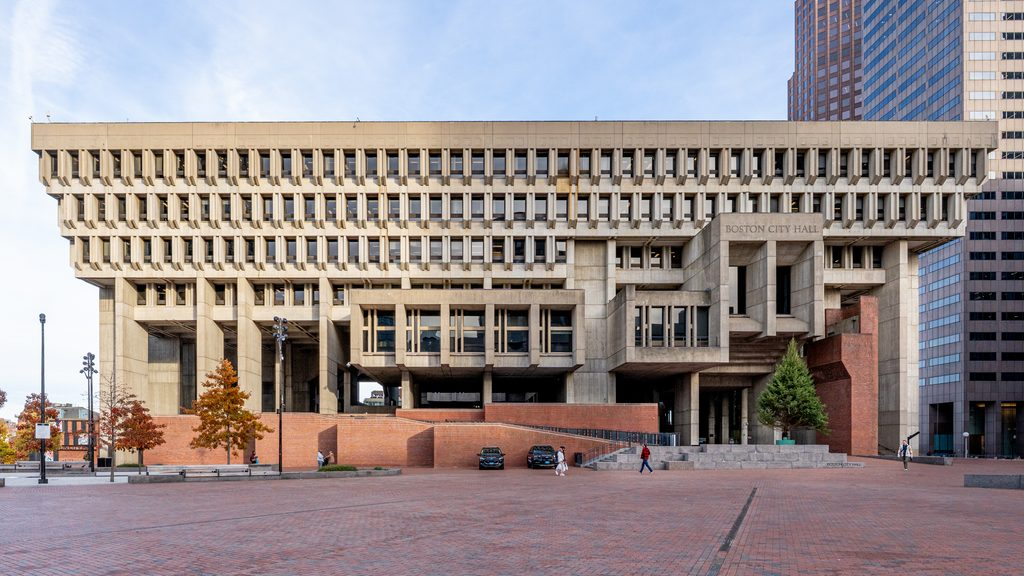
It is a classic example of the Brutalist architectural style, defined by massive, exposed concrete. The Commission called it a “significant departure from the traditional brick and brownstone materials” of Boston’s past. (Although City Hall does incorporate some red brick.)
Boston.com readers voted City Hall the ugliest building in Boston in 2023. Kallmann had defended it in a 2012 Boston Globe interview, saying that “art is not what pleases you immediately.”
On December 10, 2024, the Landmarks Commission voted unanimously to recognize City Hall as a historic landmark. Its 2023 study report calls the building “an architectural and cultural icon.”
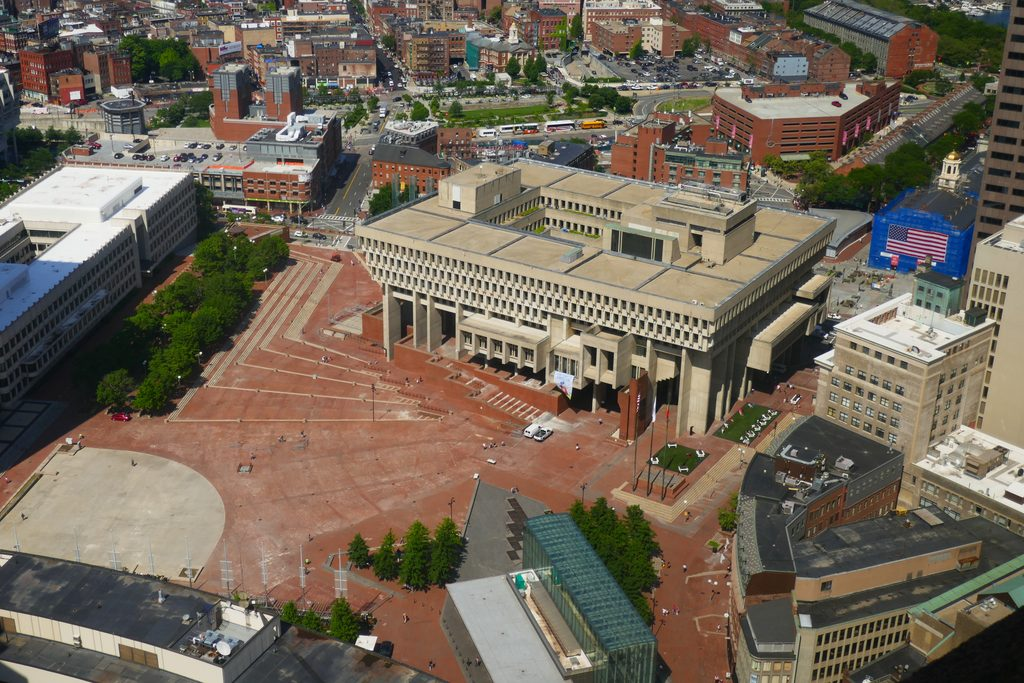
The plaza itself has also drawn criticism. Boston.com called it a “brick desert” in 2016.
The Scollay Tile Signs Hidden in Government Center Station
Although the square was erased above ground, its name survived underground in tilework that was hidden until 2014.
Scollay station opened in 1898, and a second platform below it, called Scollay Under, opened in 1916 for what became the Blue Line. Both stations were renamed Government Center after the square was razed.
The platform’s white-and-burgundy tile “Scollay Under” signs date to its 1916 construction, but they were later hidden, one behind a 1960s-era sign and another behind a wall of concrete blocks. An MBTA resident engineer said that “back then in the ’60s, there was not a lot of thought into covering up things that were historic.”
Crews found both signs in 2014, during a two-year renovation that closed the station. The station reopened in 2016 with the “Scollay” and “Scollay Under” mosaics restored for better display.
What Remains of Scollay Square Today
Beyond the station, the square survives in a few objects that are scattered and easy to miss.
The Old Howard’s sign now hangs in a dance studio at the Umbrella arts center in Concord. A large ornamental tea kettle from a former square tea shop sits above a Starbucks.
The Paramount Theatre’s vertical sign, designed in 1932 by Arthur H. Bowditch, survives on Washington Street. Emerson College restored it in 2010.
Radio host Jerry Williams campaigned in 1986–87 to restore the name. A 1987 ceremony recognized the area as “Government Center at Scollay Square,” though it’s still mostly called Government Center.
Sources
“Scollay Square,” The West End Museum, https://thewestendmuseum.org/history/era/immigrant-neighborhood/scollay-square/
“The Signscape of Scollay Square,” The West End Museum, https://thewestendmuseum.org/?p=21405
“The Howard Athenaeum,” The West End Museum, https://thewestendmuseum.org/?p=5974
“Howard Athenaeum,” Buildings of New England, https://buildingsofnewengland.com/tag/quincy-granite
“At revamped Government Center station, echoes of a burlesque past,” Boston.com, https://www.boston.com/news/local-news/2016/03/18/at-revamped-government-center-station-echoes-of-a-burlesque-past
“Second Scollay Under sign found at Government Center,” The Boston Globe, https://www.bostonglobe.com/2014/05/07/government-center-crews-discover-second-hidden-scollay-under-sign/mqah2FC3VoxNtd6C4McPUL/story.html
“Boston City Hall one step closer to historic landmark designation,” Boston.com, https://www.boston.com/news/local-news/2024/12/17/boston-city-hall-one-step-closer-to-historic-landmark-designation/
“Wu announces City Hall as the newest historic landmark in Boston,” Beacon Hill Times, http://beaconhilltimes.com/2025/01/29/wu-announces-city-hall-as-the-newest-historic-landmark-in-boston/
“Sears’ Crescent and Sears’ Block,” National Park Service NPGallery, https://npgallery.nps.gov/AssetDetail/3b41e918-c78d-42ce-9ea4-8e6a8e3222ef
“Charlie on the MTA,” https://web.mit.edu/people/jdreed/t/charlie.html