Buffalo Central Terminal: An Art Deco Icon Abandoned, Now Being Reborn
On June 22, 1929, a crowd of 2,200 people gathered to watch the first train depart from Buffalo’s grand new train station.
Fifty years later, the last train would leave in the early hours of an October morning, and the building would sit largely abandoned for nearly two decades afterward.
Then, after having many of its architectural details removed and a couple of adaptive reuse false starts, it is finally on a path back to restoration and public use once again.
Buffalo Central Terminal’s 1929 Grand Opening
https://www.newspapers.com/article/the-buffalo-times/204051426/
Article from Jun 22, 1929 The Buffalo Times (Buffalo, New York)
Buffalo Central Terminal was designed by Fellheimer and Wagner for the New York Central Railroad, at a cost of roughly $14 million.
Alfred T. Fellheimer, the firm’s principal architect, had also designed Grand Central Terminal in New York City, and Buffalo’s station shared much of the same Art Deco ambition on a smaller scale.
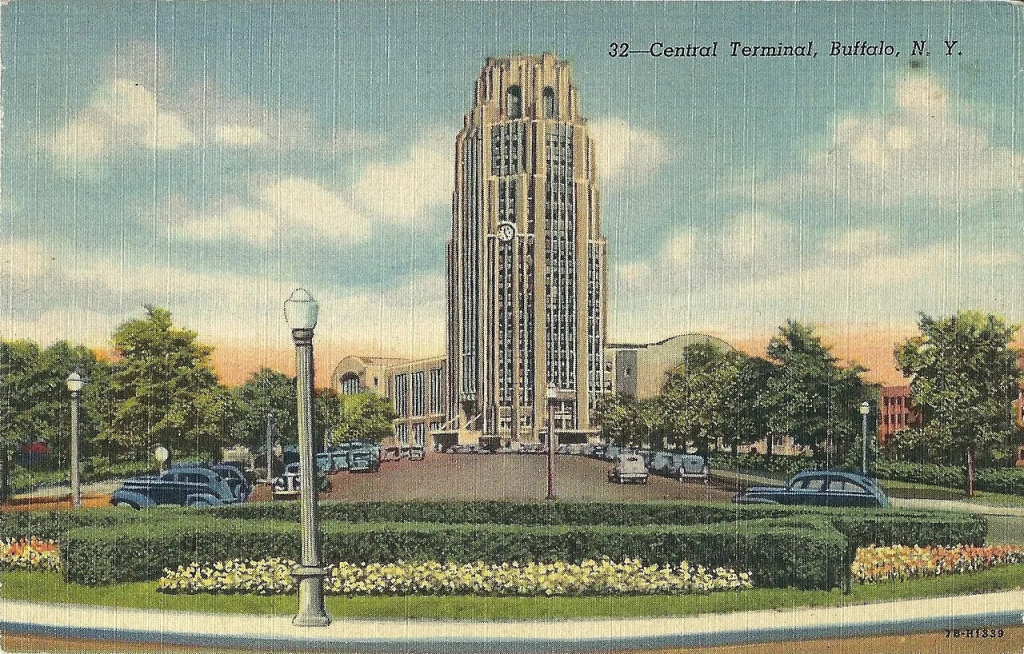
Along with Buffalo City Hall, completed two years later in 1931, it’s considered one of the city’s two most significant Art Deco landmarks, and the two buildings share a family resemblance, both employing setback massing and Indigenous American decorative motifs.
Inside, the main concourse was topped with a Guastavino vaulted ceiling built from Akoustolith tile, a porous terra cotta material designed specifically to absorb sound in a hall built to handle thousands of passengers at once.
At 17 stories, the terminal was built to handle more than 200 trains and 10,000 passengers a day, along with 1,500 New York Central employees, and included its own restaurant, soda fountain, and shops inside the main concourse.
Why Buffalo Central Terminal Closed
Passenger rail travel declined steadily across the country after World War II, as automobiles and air travel took over most long-distance trips.
The New York Central put the terminal up for sale as early as 1955, but found little interest in such a large building.
Ownership passed through several companies over the following decades, including a 1968 merger into Penn Central, and then Amtrak service beginning in 1971.
By then the terminal’s cavernous concourse was seeing far less use than it had been built for.
It had only two lines and only four daily trains passed through.
The last train left Buffalo Central Terminal on October 28, 1979.
Amtrack moved its service to the new Buffalo-Depew station located 10 miles east of Downtown Buffalo, an austere terminal with concrete block walls.
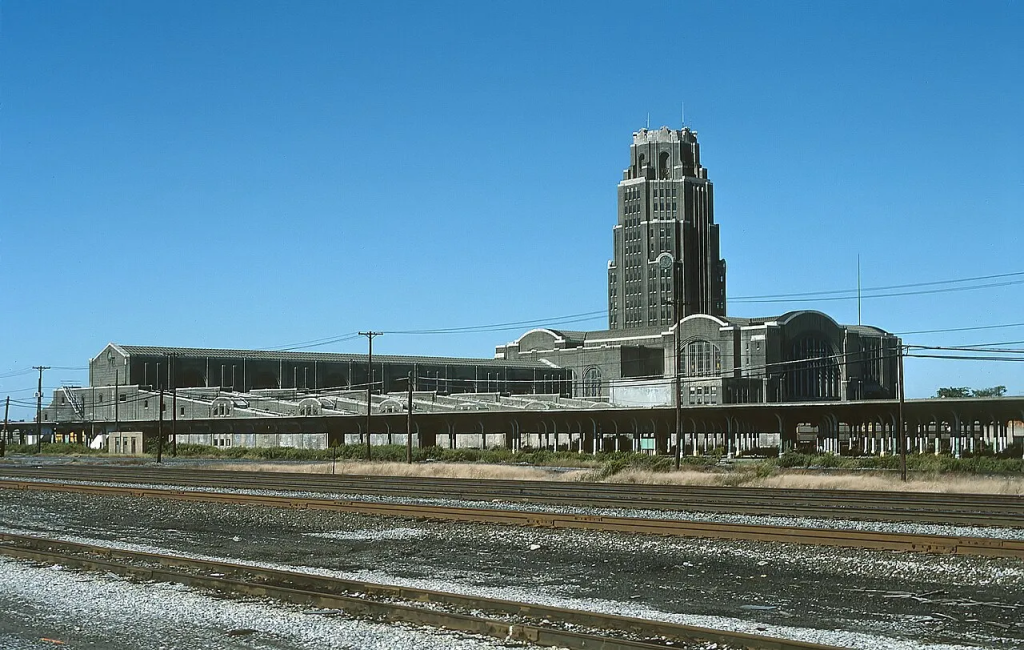
Buffalo Central Terminal in 1987 (photo via Roger Puta, Wikimedia Commons)
The Terminal’s Years as an Abandoned Train Station
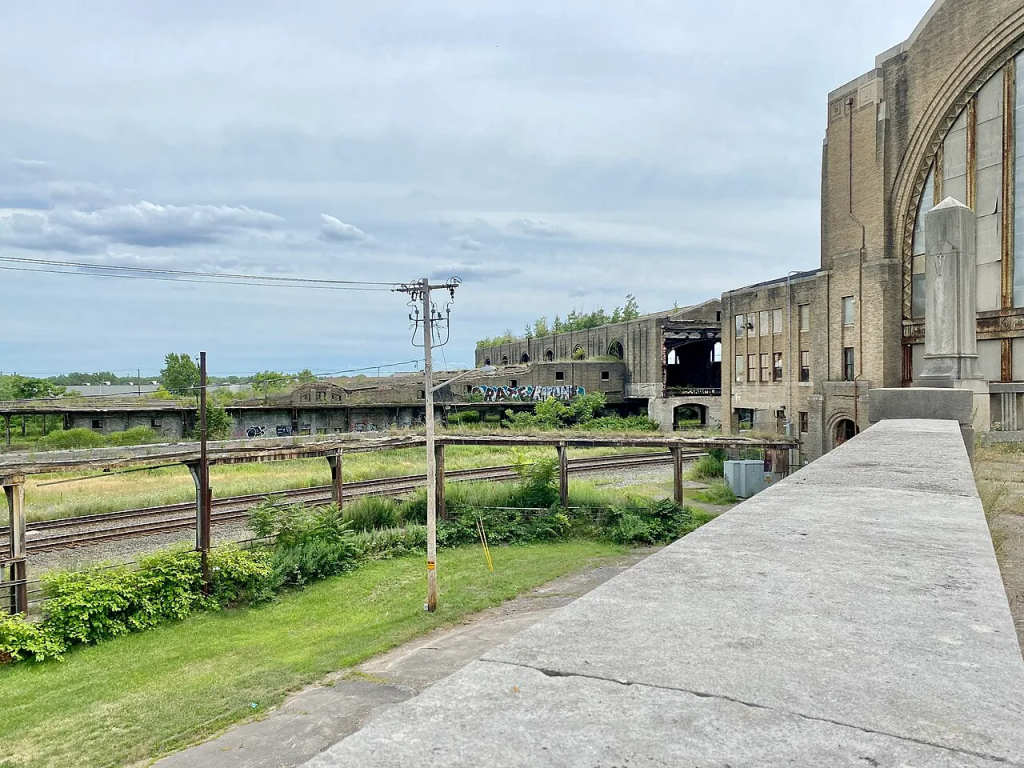
Local developer Anthony Fedele purchased the closed terminal for just $75,000 after it stopped operating.
The building sat largely empty through the 1980s. The railroad offices closed in 1980 and the final business left in the terminal, the Conrail Dispatching Department, vacated it in 1984.
A foreclosure sale in the middle of that decade left it especially vulnerable to theft and vandalism. New owners removed and sold some elements of the complex that had value.
The building was not secured which left it at risk to thieves and even arson attempts.
Original Art Deco fixtures were stripped out and sold off piece by piece, including one ornate lamp that reportedly ended up decorating a nightclub in Hong Kong.
Possible redevelopment plans included using the terminal as a banquet hall and a stop on a new high-speed rail line. Another around 1900 would have turned it into a light manufacturing building and warehouse.
Restoring Buffalo Central Terminal
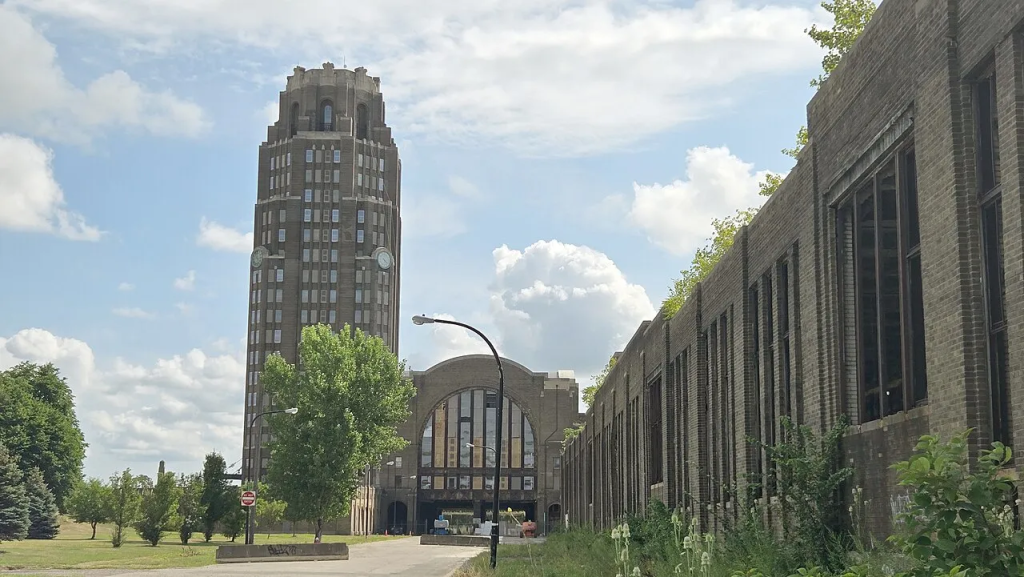
The administration tower and passenger terminal, with the freight terminal to the right (Image via oaktree_b, Wikimedia Commons)
The Central Terminal Restoration Corporation formed in 1997 and acquired the building, beginning a slow process of stabilizing and repairing the structure.
The terminal reopened for public tours in 2003, and the nonprofit has continued restoration work in the decades since, including new windows and rooftop solar panels.
The current phase of work, a $33 million stabilization project backed by New York State and philanthropic partners, reached its halfway point in January 2026.
Crews are repairing masonry on the tower and parking garage, replacing decades-damaged roofing, and restoring the Guastavino ceiling’s Akoustolith tiles, work the project’s architect has called a showcase for what the rest of the concourse could eventually look like.
The goal is to reopen the passenger concourse for limited public use by 2027, as part of a broader $300 million master plan that would focus on completing stabilization and eventually convert the complex into a public plaza and cultural center, with other uses including a restaurant, retail, and apartments in the long-vacant baggage and post office buildings.
The plan does not require passenger rail to return to the terminal, but a movement to do just that arose in 2016, involving Buffalo congressman Brian Higgins. That may not ever happen and there are no active proposals today, but it would surely be the most appropriate way to honor this history of this Art Deco landmark.
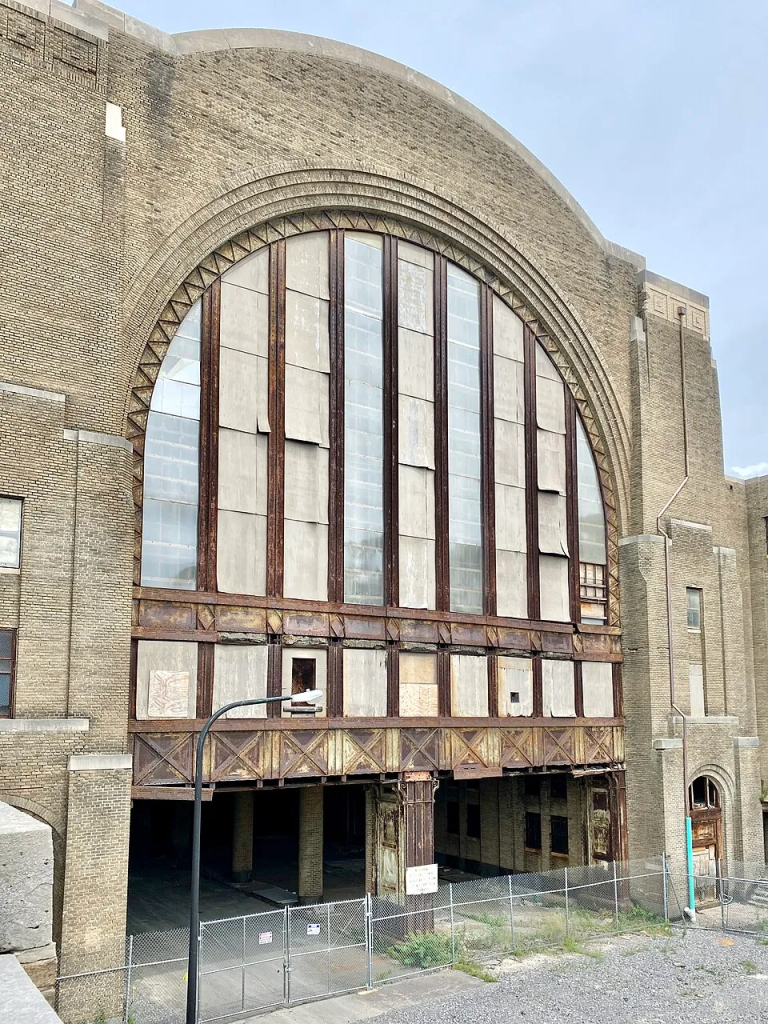
Image via w_lemay, Wikimedia Commons
Next to read: To learn about another historic train terminal that was rehabbed and reborn as a major destination in its city, read our article on Denver’s Union Station.
Sources
Buffalo Central Terminal Restoration Corporation, “History & Restoration“
Trains Magazine, “Reflections of Buffalo Central Terminal“
Atlas Obscura, “Peek Inside Buffalo’s Abandoned Art Deco Train Terminal“
Roadtrippers, “The once-abandoned Buffalo Central Terminal turns 90“