Camden Station: How Camden Yards Preserved a Historic Railroad Depot and Warehouse
Camden Yards, built in 1992 in Downtown Baltimore, is famous for looking like an old-fashioned ballpark.
Much of that feel comes from the fact that it incorporated a real historic freight warehouse into the design, and the project also helped save the 19th-century railroad depot as a gateway.
Camden Station’s Construction for the B&O Railroad
Camden Station dates back to 1852, when the board of the Baltimore & Ohio railroad approved purchasing five blocks of land on Camden Street for $600,000 to replace the company’s existing Mount Clare Station with a larger, more central depot.
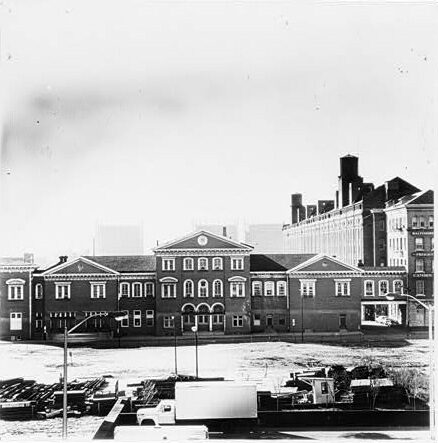
The station was designed by architects Niernsee and Neilson, with Baltimore architect Joseph F. Kemp contributing to the final version, a 3-story brick building in the Italianate style with three towers, including a center tower originally 185 feet tall. Construction began in 1856 and was completed in 1867, delayed partly by the Civil War.
The station initially served as the B&O’s main passenger and freight terminal, as well as its corporate headquarters and offices.
Camden Station also played a role in the Civil War: news of the attack on Fort Sumter first reached Baltimore at the station’s own telegraph office, and just a week later, Union troops marching toward the station were attacked by a pro-Confederate mob nearby, in what’s often cited as the war’s first bloodshed.
Abraham Lincoln passed through the station four times during the following years, including as part of his 1865 funeral train’s first stop. In 1877 during a national railroad strike, rioters even tried and failed to burn the station building down.
Camden Station was also the site of more than one technological milestone. On June 27, 1895, Camden Station was the site of the first mainline electrification of a steam railroad in the United States, when an electric locomotive pulled a Royal Blue train through the Howard Street Tunnel.
In 1937, Camden Station’s lower-level platforms saw the first streamlined, non-articulated diesel locomotive in the U.S. begin service, also pulling the Royal Blue.
And long before the Camden Yards ballpark was built, when the modern-era Baltimore Orioles began play in the city in 1954, the team arrived at Camden Station by B&O train for their inaugural home opener.
How The Orioles’ New Ballpark Saved Camden Station and the B&O Warehouse
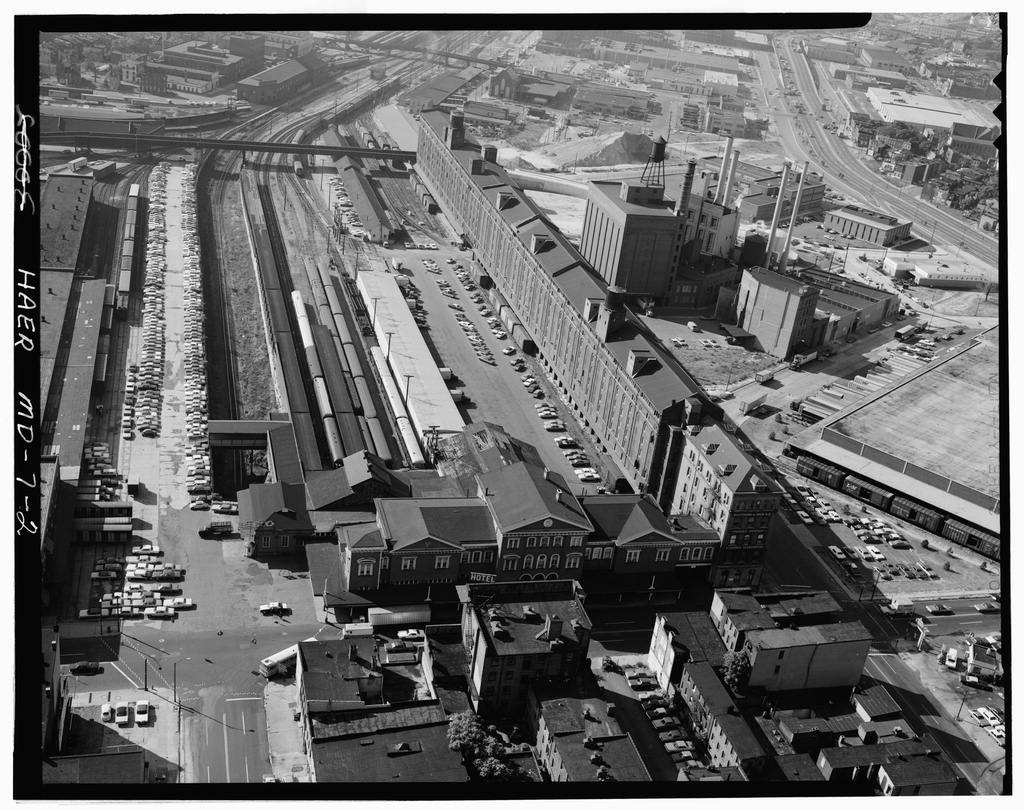
Source: Library of Congress
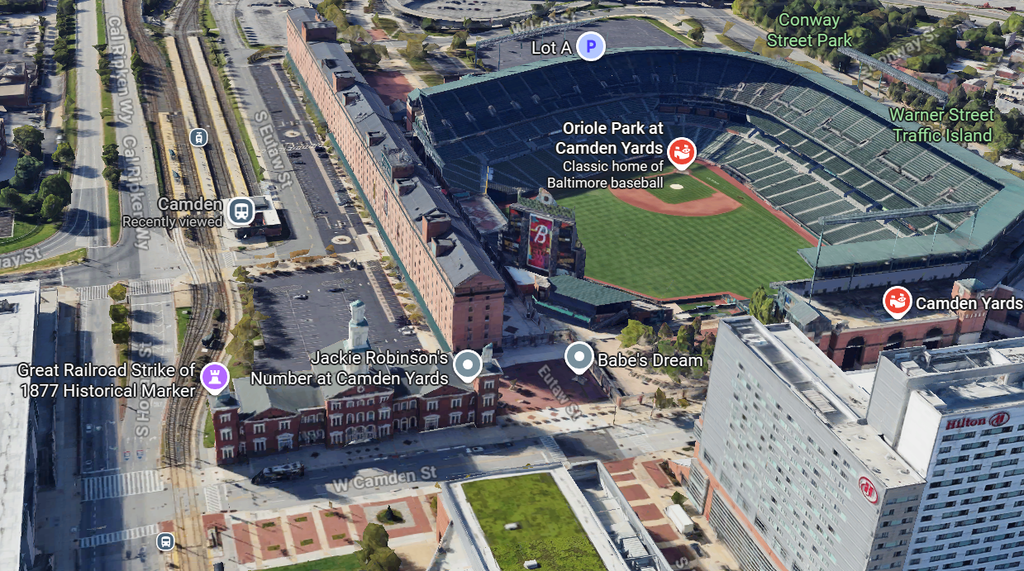
The B&O left Camden Station in 1971 and sold the building to the Maryland Stadium Authority. After that, the vacant station was in serious danger of structural damage and becoming unsalvageable.
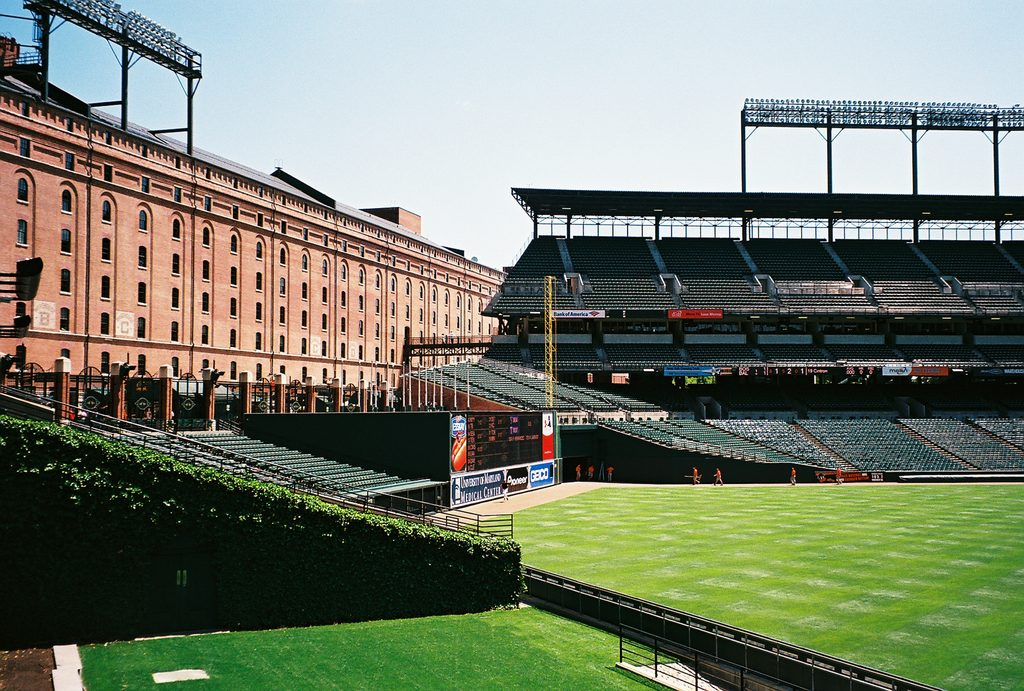
In the late 1980s, the Maryland Stadium Authority began planning a new ballpark for the Baltimore Orioles to replace their aging Memorial Stadium. Architecture firm HOK Sport broke ground on June 28, 1989, and Oriole Park at Camden Yards opened April 6, 1992, becoming the first of the “retro” ballparks built to evoke early-20th-century stadium design rather than the concrete, multipurpose stadiums common since the 1960s and 70s.
The Stadium Authority restored Camden Station’s exterior for Oriole Park’s 1992 opening, returning its facade to its 1867 appearance.
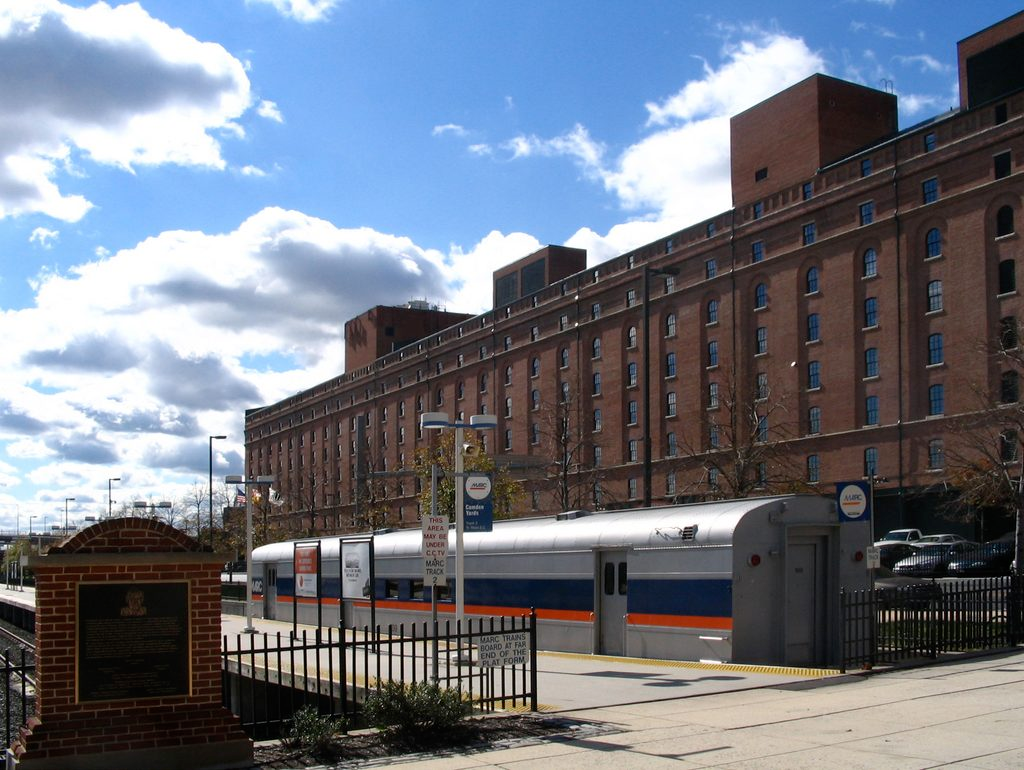
The project also preserved the huge B&O freight warehouse designed by architect E. Francis Baldwin and built in 1899-1905 rather than demolishing it. At 1,116 feet long and 8 stories tall, it now looms over the stadium’s right-field wall and houses Orioles offices and a team store.
Camden Station Today
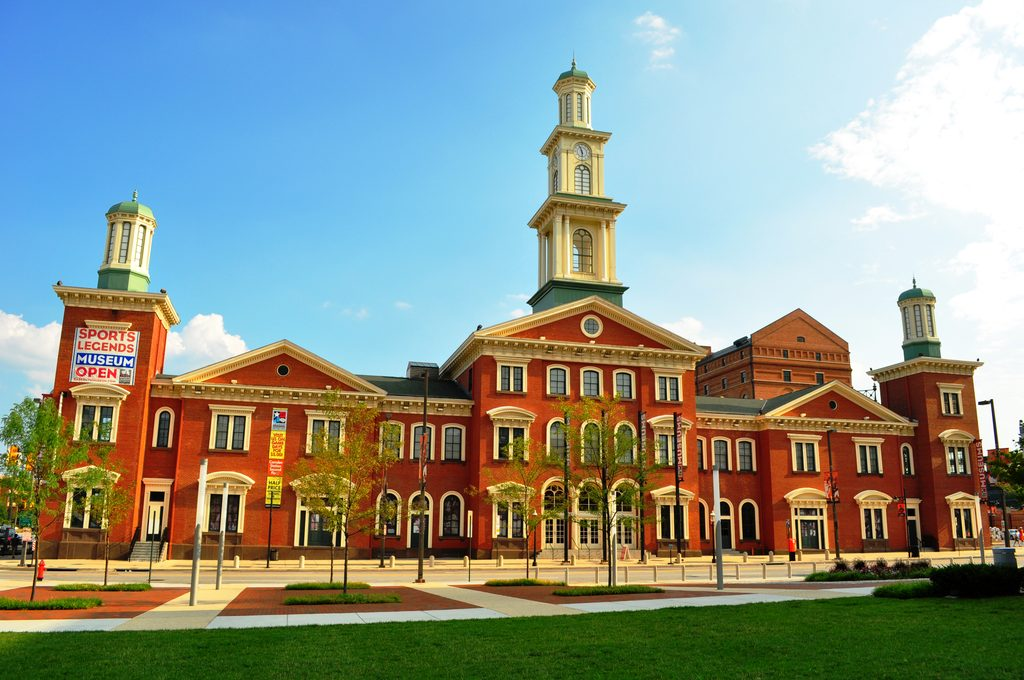
Camden Station’s interior was fully restored in 2005, preserving original fixtures including hanging lights, waiting room benches, historic doors, and cornice work, with damaged elements recast as exact replicas.
Sports Legends Museum opened in the restored building on May 14, 2005, with Julia Ruth Stevens, daughter of Babe Ruth, in attendance.
Geppi’s Entertainment Museum, a privately-owned pop culture museum, opened on the building’s upper level in September 2006.
But the Sports Legends Museum closed on October 12, 2015, after the Maryland Stadium Authority declined to renew its lease. And Geppi’s Entertainment Museum closed in 2018, with its collections moving to the Library of Congress.
The historic station has largely sat vacant since, although a new, permanent modern MARC and Light Rail station building opened near it in September of 2019.
Sources
“Camden Station,” Explore Baltimore Heritage. https://explore.baltimoreheritage.org/items/show/170
“The Pratt Street Riot,” National Park Service. https://www.nps.gov/articles/the-pratt-street-riot.htm
Historical Marker Database, hmdb.org. https://www.hmdb.org/m.asp?m=219702
“Camden Station,” Maryland Stadium Authority. https://mdstad.com/camden-station
“Of Ballparks and Battlefields, A Tale of Two Camdens,” American Battlefield Trust. https://www.battlefields.org/learn/articles/head-tilting-history/ballparks-and-battlefields-tale-two-camdens
“New Train Station Opens at Camden Yards,” Baltimore Fishbowl. https://baltimorefishbowl.com/stories/new-train-station-opens-at-camden-yards/
“Urban Landscape, Deciding the Fate of Camden Station,” Baltimore Fishbowl. https://baltimorefishbowl.com/stories/urban-landscape-deciding-fate-camden-station-trader-joes-moves-within-towson-monument-city-brewing-opens-highlandtown-robert-kanigel-jane-jacobs/
“Sports Legends Museum Closes Its Doors,” Baltimore Sun, October 12, 2015. https://www.baltimoresun.com/2015/10/12/sports-legends-museum-closes-its-doors/
“Geppi’s Entertainment Museum to Close as Comic and Art Collection Heads to Library of Congress,” Baltimore Sun, May 30, 2018. https://www.baltimoresun.com/2018/05/30/geppis-entertainment-museum-to-close-as-comic-and-art-collection-heads-to-library-of-congress/
“Sports History Hits Home at Museum,” Baltimore Sun, May 15, 2005.
“Trains, Buses and Boats, How Baltimore Used to Travel,” Baltimore Sun, 2009. https://www.baltimoresun.com/2009/03/22/trains-buses-and-boats-how-baltimore-used-to-travel/
Janet Greenstein Potter, Great American Railroad Stations, John Wiley and Sons, 1996.
Timothy Jacobs, The History of the Baltimore and Ohio, Crescent Books, 1989.