
Lee Plaza: The Rise, Abandonment, and Redevelopment of a Detroit Art Deco Landmark
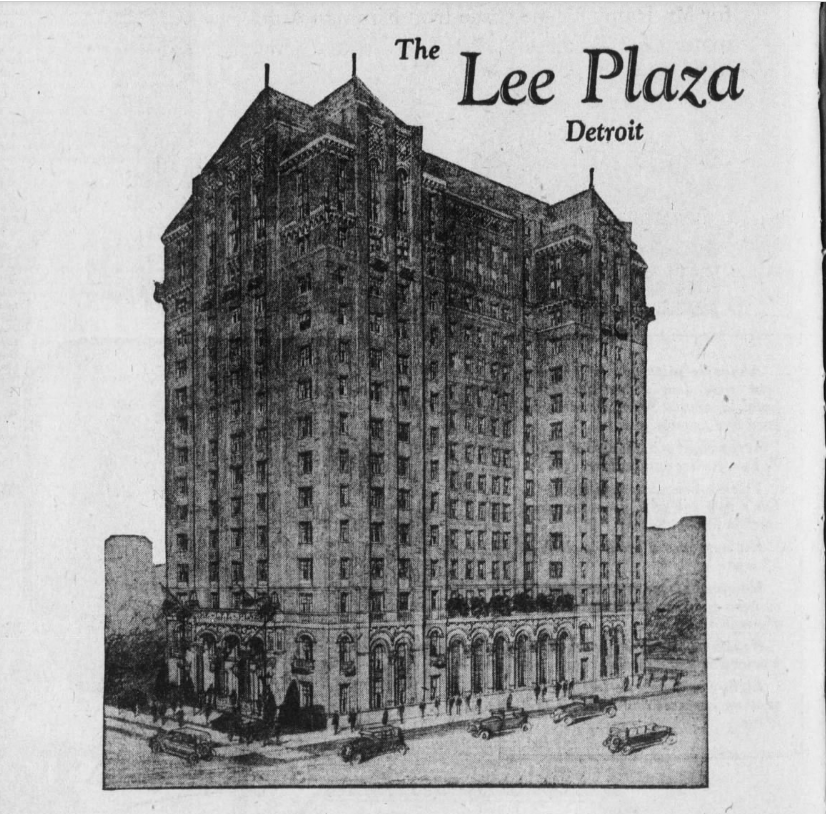
In May 2025, construction crews broke ground on the redevelopment of Detroit’s Lee Plaza, a 15-story Art Deco tower on West Grand Boulevard that had sat vacant and deteriorating for nearly three decades.
The project, led by the Roxbury Group and Ethos Development Partners, carries a $60 million price tag and according to recent news reports is now nearing completion and will reopen by November of 2026 as over 100 new senior apartments.
When it was empty, the building was best known as a destination for urban explorers and ruin photographers. Its gutted ballroom, graffiti-covered hallways, and gaping holes where terra cotta ornamentation had been pried from the facade became some of the most reproduced images showing the decline of Detroit.
The building’s original story, however, was one of glamor and luxury.
The Luxury Lee Plaza Hotel, “A 17-Story Lighthouse”
When the Lee Plaza opened for occupancy on December 1, 1929, developer Ralph T. Lee called it “the finest thing of its kind in America.” And it wasn’t just empty boosterism.
Atop the building, a 9,000,000-candlepower beacon blazed from sunset to sunrise as a guide to air pilots passing over Detroit after nightfall. The aviation bureau of the US Department of Commerce had designated the Lee Plaza as the beacon site for the city of Detroit: each night, an engineer in the building’s basement threw a switch and the massive roof lamp illuminated the sky for miles in every direction (historicdetroit.org). The Lee Plaza was, as the Detroit Free Press put it at the time, “a 17-story lighthouse.”
The Art Deco style building was designed by architect Charles Noble for Ralph T. Lee, a self-made real estate developer who had built and sold more than $10 million in Detroit apartment buildings before conceiving the Lee Plaza as the culmination of his career.
The general contractor was the Otto Misch Company, working with reinforced concrete construction and a facade of orange-glazed face brick and terra cotta. Sixteen stories rose above West Grand Boulevard at Lawton Street, positioned to draw tenants from New Center, where General Motors had recently established its world headquarters.
Lee Plaza served as a luxury residential hotel, where occupants rented apartments in which to live for a longer period of time than standard hotels. Its 200 individual apartments ranged from one to four rooms, but the building’s real distinction was its shared spaces. The lobby was finished in Italian marble, with wrought iron fixtures and two oak-paneled lounges, one with a large fireplace.
Through the center of the lobby ran Peacock Alley: a barrel-ceilinged, mirror-walled corridor extending 88 feet to the rear of the building, its vaulted ceiling hand-painted in blues, golds, and greens.
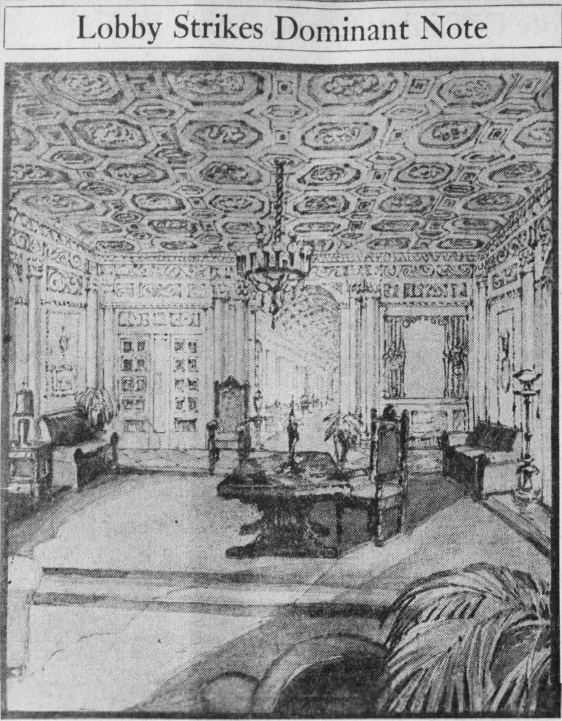
To the right was the dining room, seating 125 in green leather chairs beneath a high coffered ceiling described as among the most elegant in Detroit. To the left was the ballroom, “a stimulating setting for life’s gayer moments,” with a vaulted ceiling, four crystal chandeliers, and mirrored panels that made the room appear even larger than its considerable size.
Three gearless elevators ran from the first to the seventeenth floor, their shaft doors cast in bronze. In the basement were billiard parlors, beauty parlors, a barber shop, a valet, and a commissary.
The elaborate decorative work throughout the public rooms was done by Corrado Parducci, a Detroit-based architectural sculptor whose commissions also included the ornamental details of the Guardian, Penobscot, and Buhl Buildings. Here, they include coffered lobby ceiling, the hand-painted barrel vault of Peacock Alley, and the plasterwork in the ballroom. (National Register of Historic Places nomination)
The Free Press echoed Lee in saying that “there will be nothing remotely like the Lee Plaza anywhere in this country.”
Decline and Notoriety as a Vacant High Rise
For all of the building’s grandeur, the timing of its construction would prove unfortunate.
The Lee Plaza opened months before the stock market crash of 1929, and Lee himself was bankrupt within a few years.
He sold the building to the Detroit Investment Company, which fell behind on payments by $1.1 million by December 1930.
The building passed through a series of owners before the City of Detroit acquired it through the Housing Commission in 1968, repurposing it as low-income senior housing, which it remained for nearly three more decades before federal funding changes made the aging structure too expensive to operate. It closed in 1997.
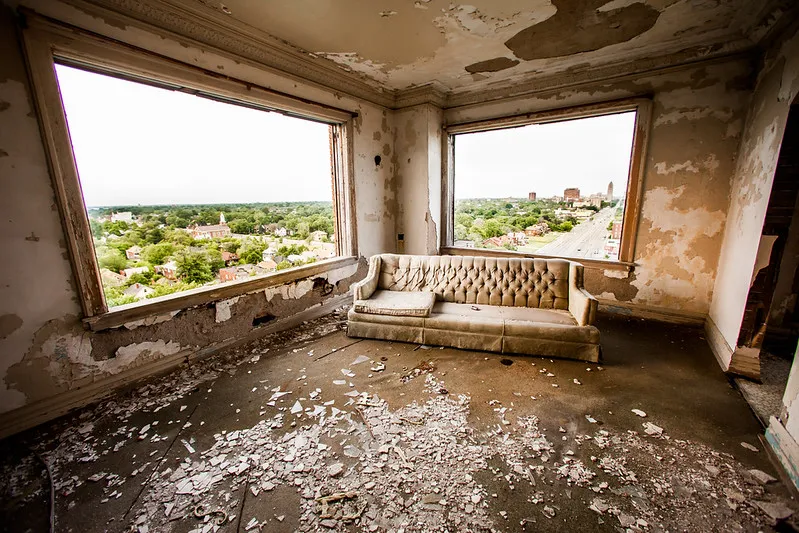
Photo credit: Thomas Hawk
What followed was a slow and well-documented deterioration. Stripped of its architectural elements by scavengers, exposed to the elements through broken windows and a compromised roof, the Lee Plaza became a fixture in the visual vocabulary of Detroit’s struggles with deindustrialization and disinvestment.
Its gutted ballroom, the same spot where crystal chandeliers once hung above a hand-colored vaulted ceiling, became one of the most photographed spaces in the city, featured in the internationally exhibited 2010 photography book The Ruins of Detroit by Yves Marchand and Romain Meffre.
As documented by Historic Detroit, the theft of the terra cotta lion heads became a particular cause célèbre. Removed from the building’s exterior, they eventually turned up incorporated into an award-winning condominium redevelopment in Chicago, a cross-state legal and preservationist fight that drew national attention and illustrated both the appetite for architectural salvage and the vulnerability of unprotected historic buildings. Some of those lion heads are now being recreated for the restoration.
Multiple redevelopment proposals came and went. A 2015 plan announced a $200 million redevelopment; by 2016 it had collapsed. The city issued new requests for proposals in 2017 and 2018, finding no viable path either time. The building continued to decay.
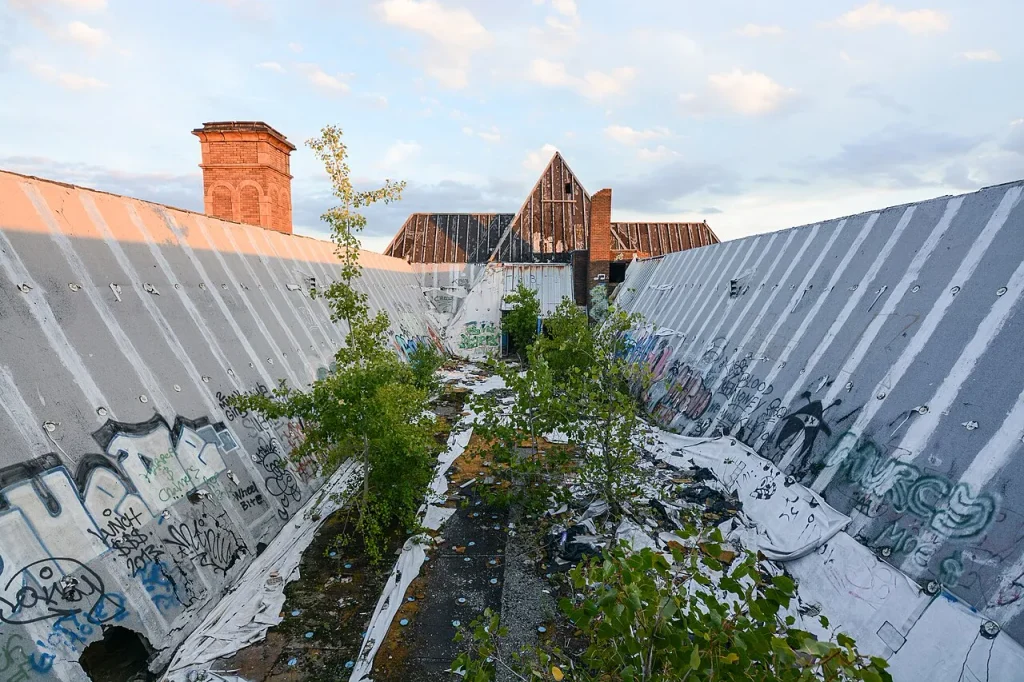
Photo Credit: Roman Kahler
How Detroit Finally Saved the Lee Plaza
When project finally broke ground in 2025, it was seven years in the making.
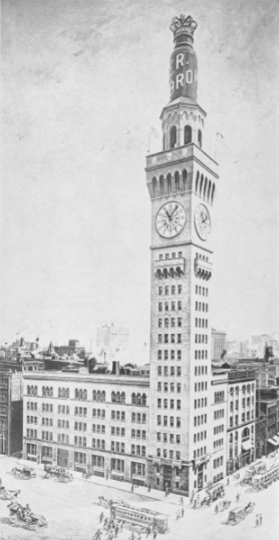
The Roxbury Group, who previously saved the Metropolitan Building and David Whitney Building from demolition, acquired Lee Plaza from the city in 2019 for $350,000.
They spent the following years assembling a complex financing package drawing on Low Income Housing Tax Credits, HUD rental subsidies, American Rescue Plan Act funds, and state and local sources.
The $60 million first phase will restore 117 units of affordable housing for seniors earning at or below 50% of area median income, with affordability guaranteed for at least 45 years.
The upper floors will contain affordable apartments not limited to seniors.
The iconic ballroom is being restored, and preservation experts are repairing cornices, spandrel plaques, and the historic wood-paneled lounges. (City of Detroit, May 2025; WhatNow Detroit, May 2025)
The Lee Plaza story is not unique to Detroit. Across the industrial Midwest, cities have seen landmark buildings pass through cycles of grandeur and decline, and whether they get demolished or adapted for a new life can sometimes seem to be a matter of pure chance.
In this case it’s interesting how the building stayed in the public consciousness through its ruin photography, and it fortunately survived just long enough for a viable path forward to emerge.
And soon, the building will once again be occupied, with recreated lion heads and a restored Peacock Alley for residents to once again stroll down.
Sources:
- Detroit Free Press, November 27, 1927, pp. 63 and 65
- City of Detroit, “Long-planned Restoration of Iconic Lee Plaza begins,” May 13, 2025, https://detroitmi.gov/news/long-planned-restoration-iconic-lee-plaza-begins-will-include-117-units-senior-affordable-housing
- Historic Detroit, “Lee Plaza,” https://historicdetroit.org/buildings/lee-plaza
- Crain’s Detroit Business, “Historic Lee Plaza starts a new chapter as senior housing,” May 14, 2025, https://www.crainsdetroit.com/real-estate/historic-lee-plaza-starts-new-chapter-senior-housing
- Detroit News, “Work starts to restore Detroit’s long-vacant Lee Plaza,” May 13, 2025, https://eu.detroitnews.com/story/business/2025/05/13/work-starts-to-restore-long-vacant-lee-plaza-for-senior-housing/83579564007/
- Historic Structures, “Lee Plaza Hotel, Detroit Michigan,” https://www.historic-structures.com/mi/detroit/lee-plaza-hotel/
- WhatNow Detroit, “Detroit’s Historic Lee Plaza to be Transformed into Affordable Senior Housing,” May 14, 2025, https://whatnow.com/detroit/real-estate/detroits-historic-lee-plaza-to-be-transformed-into-affordable-senior-housing/
- National Register of Historic Places nomination, Lee Plaza Hotel, 1981