Freedman’s Town to Uptown Dallas: The Redlined Neighborhood a Cowboys Player Turned Into a Walkable Boomtown
This week I was listening to a Strong Towns podcast episode with Patrick Kennedy, and while describing an area of Dallas that was surprisingly walkable, he said “all of this was because a former Dallas cowboy read Jane Jacobs and asked, ‘why don’t people live closer to where they work?'” The whole interview was great but that tidbit especially fascinated me, so I had to dig into its history.
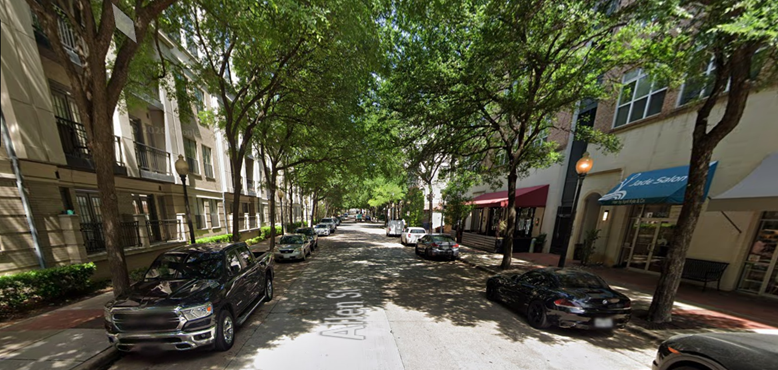
Just north of downtown Dallas sits Uptown, a dense, walkable district of high-rise apartments, restaurants, and office towers that regularly ranks among the most desirable places to live in Texas. Little about it today suggests what stood there before.
Uptown was originally outside the city limits of Dallas, home to communities not welcome downtown, a Hispanic neighborhood called Little Mexico on its west side, and Freedman’s Town, founded by emancipated Black Texans, on its east. This is the history of how those neighborhoods gave way to Uptown, and how a former Dallas Cowboys center played a direct role in that transformation.
Freedman’s Town: Dallas’s Freedmen’s Community Founded in 1865
North Dallas Freedman’s Town was established in 1865 by formerly enslaved Black Texans settling just outside the city limits, one of several freedmen’s communities that sprang up around Dallas in the years after emancipation.
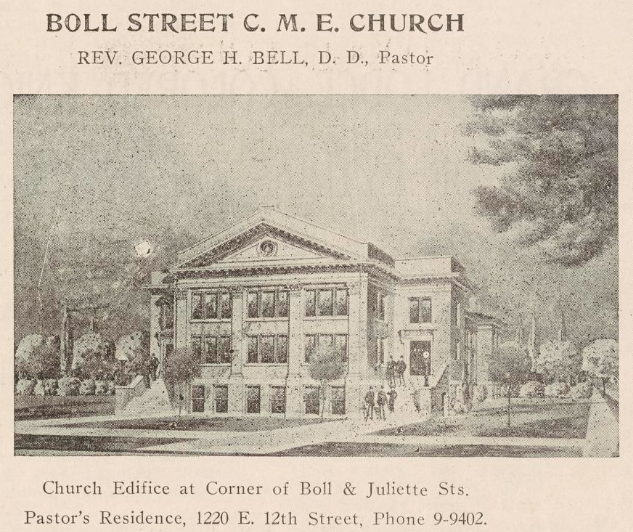
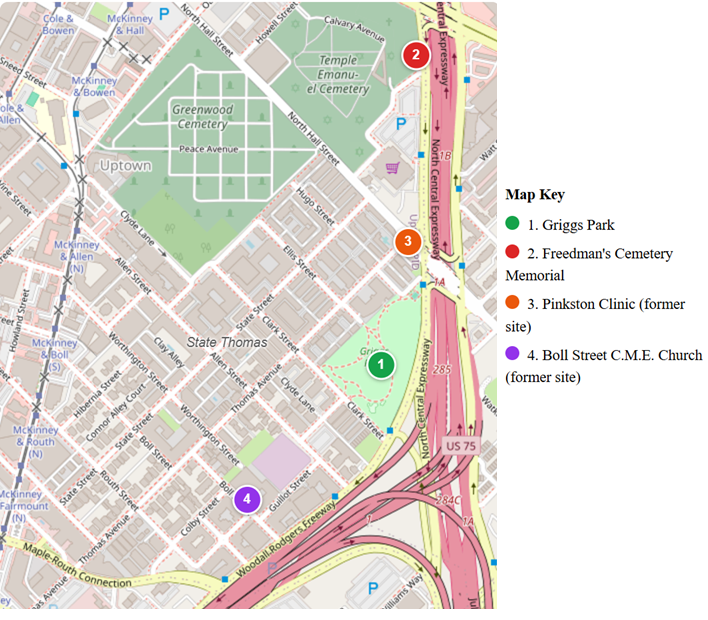
The community was incorporated into the city of Dallas in 1874 and grew into a self-sustaining neighborhood with its own churches, schools, and businesses, including institutions like St. Paul United Methodist Church, founded in 1873, and the Pinkston Clinic on Thomas Avenue, which advertised itself directly to Black Dallas residents at a time when white-owned hospitals largely denied them care.
By the early 20th century, the neighborhood was more commonly known as North Dallas, and later still as State-Thomas.
How Highways and Redlining Erased Freedman’s Town
Dallas’s 1944 Master Plan labeled the city’s Black neighborhoods as blighted, describing blocks of “weather-beaten, unpainted shacks so close together a man could stand between two houses and touch them both with his arms barely extended” (Bartholomew and Associates).
City officials used eminent domain to acquire and demolish much of the neighborhood on that basis. Construction of Central Expressway tore directly through Freedman’s Town beginning in the 1940s, and by the 1950s, city policy had formally redlined Black residents into specific sections of Dallas.
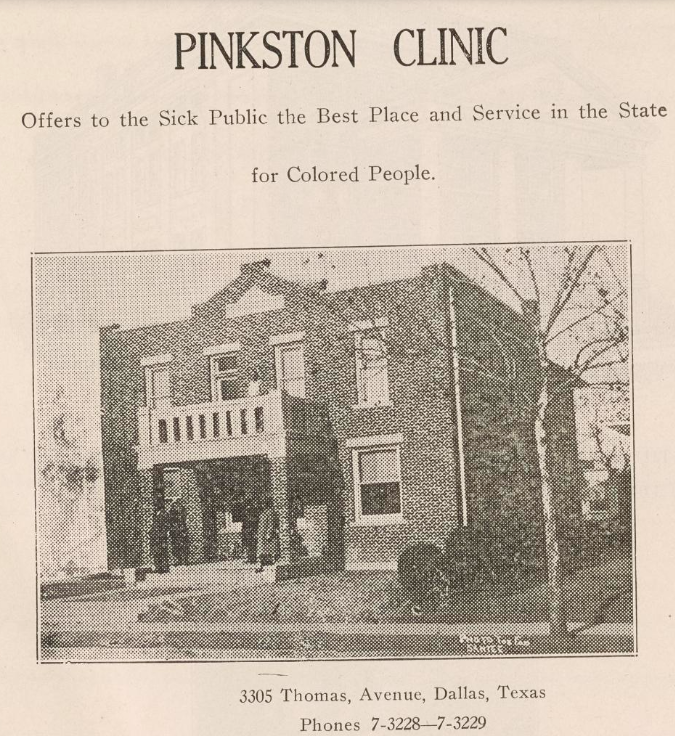
Boll Street C.M.E. Church, once a substantial brick building at the corner of Boll and Juliette streets, was among the buildings lost to this construction.
The neighborhood’s decline continued for decades afterward. In the early 1980s, the Southland Corporation bought roughly 160 acres from about a thousand property owners to build the Cityplace tower, and later in that decade, savings and loan banks bought up much of the remaining land in anticipation of new office towers that were never built.
By 1989, what had once been a dense, intact neighborhood had become mostly vacant land, with barely a house or two surviving per block.
Robert Shaw, a Former Dallas Cowboys Center, Redevelops State-Thomas
Robert Shaw was a first-round draft pick who played center for the Dallas Cowboys before a knee injury ended his NFL career after only two seasons. He went on to build a career in real estate development alongside his Cowboys teammate and mentor Roger Staubach.
In 1990, Shaw’s company broke ground on The Meridian, the first major apartment complex built on the largely vacant land left behind by decades of clearance. The project relied on the State-Thomas Tax Increment Financing district, established in 1988, the first TIF district in Dallas history, which directed a portion of new tax revenue back into rebuilding the area’s streets, water lines, and utilities.
Lending for the earliest buildings was difficult to secure domestically, and early apartments reportedly had to be filled with friends at discounted rates just to make the district look populated (D Magazine). Shaw later helped found Uptown, Inc. in 1992 to continue promoting investment in the area.
Historic Survivors: State-Thomas’s Victorian Homes and Griggs Park
Not everything from Freedman’s Town’s history was erased. Griggs Park, an eight-acre park bordering Woodall Rodgers Freeway, honors the neighborhood’s namesake, Rev. A.R. Griggs, who was born into slavery in Georgia in 1850, was emancipated at fifteen, and went on to found four Black colleges and Texas’s first African American newspaper.
A short distance away, State-Thomas today contains the largest surviving collection of Victorian-era homes in Dallas, including the Jacob and Eliza Spake House, individually listed on the National Register of Historic Places, a rare physical reminder that not every trace of the neighborhood’s older architecture was lost to clearance and redevelopment.
Freedman’s Cemetery: The Graves Found Beneath a Dallas Highway
The clearest reminder of what Freedman’s Town’s residents left behind sits along Central Expressway itself. During a 1993 expansion of the highway, construction crews discovered more than 1,100 graves beneath the roadway (City of Dallas), the remains of the same community’s own burial ground, purchased by Freedman’s Town residents in the neighborhood’s earliest years. A memorial now marks the site.
Uptown Dallas Today: Texas’s Most Walkable District
What eventually rose from that vacant land went well beyond Shaw’s first apartment complex. The Worthington followed soon after, then Cityplace’s 42-story tower in the early 1990s, and West Village’s mixed-use retail and residential development in 2000.
The building boom never really stopped. A $200 million dual-tower project, a 24-story residential building and a 20-story office building, broke ground on McKinney Avenue in 2007 and was still under construction in August 2009, in the middle of the worst national real estate collapse since the Great Depression.
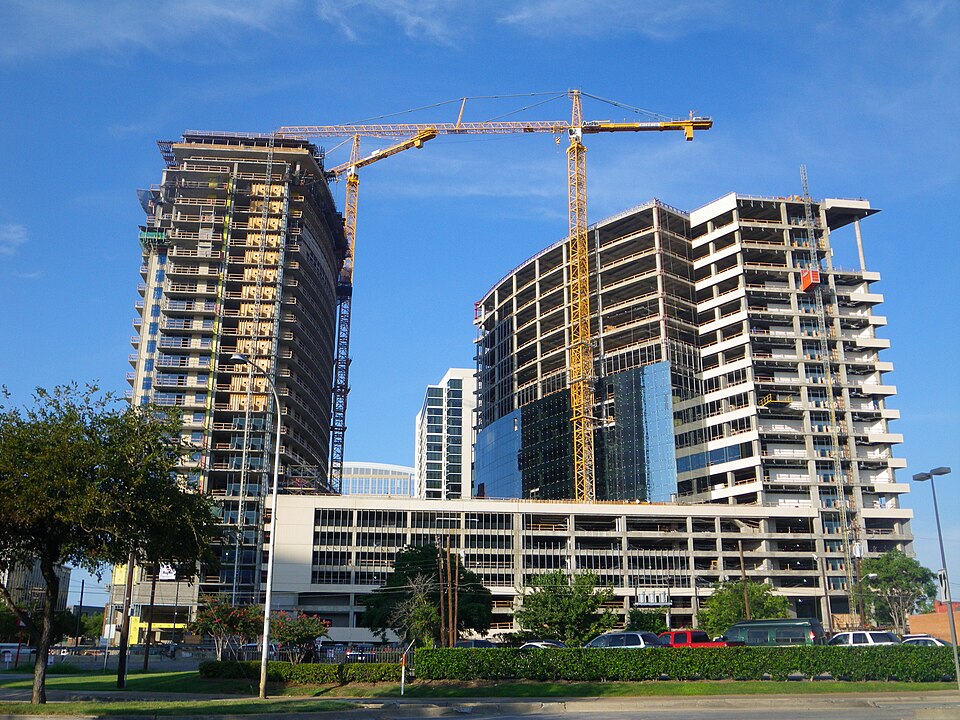
Today, Uptown is one of the most pedestrian-friendly districts in Texas, a rarity in a state built almost entirely around the automobile. Roughly 69% of residents hold a bachelor’s degree or higher, and the neighborhood is home to offices for firms like McKinsey, Goldman Sachs, and Bain.
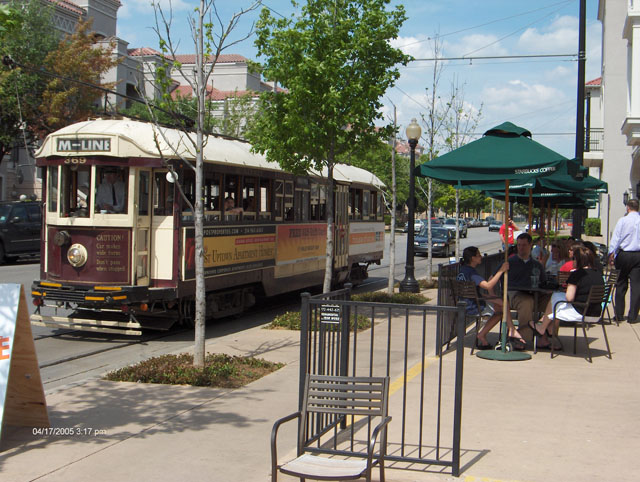
It’s also one of the only parts of Dallas with a working streetcar: the free M-Line Trolley connects Uptown to downtown, running past the West Village, McKinney Avenue, and the State-Thomas neighborhood itself.
Griggs Park’s memorial to Rev. Griggs and the Freedman’s Cemetery Memorial along Central Expressway remain two of the only physical markers connecting all of that new density back to the neighborhood that stood there before it.
Sources:
- Texas State Historical Association, “Freedmantown/North Dallas” — https://www.tshaonline.org/handbook/entries/freedmantownnorth-dallas
- City of Dallas Office of Historic Preservation, “Freedman’s Town” — https://cityofdallaspreservation.wordpress.com/tag/freedmans-town/
- Roads to Destruction: Postwar Urban Redevelopment and North Dallas Freedman’s Town (Texas Woman’s University) — https://twu.edu/media/documents/history-government/Roads-to-Destruction-Postwar-Urban-Redevelopment-and-North-Dallas-Freedman’s-Town-.pdf
- D Magazine, “State-Thomas Neighborhood 1989” — https://www.dmagazine.com/urbanism-transportation/2014/09/state-thomas-neighborhood-1989/
- Uptown Dallas, Inc., “The Uptown Story” — https://uptowndallas.net/uptown-beat/history-of-uptown/
- Uptown Dallas, Inc., “Griggs Park” — https://www.uptowndallas.net/griggs-park
- Smith, James H., Official Directory: Dallas Negro Churches, Schools and Other Activities (1930), Library of Congress-hosted via Portal to Texas History — https://texashistory.unt.edu/ark:/67531/metapth1222872/
- Flashback: Dallas, “Black Churches in Dallas — 1930” — https://flashbackdallas.com/2020/02/23/black-churches-in-dallas-1930/