The Tabor Grand Opera House: Denver’s Lost Theater of Perfection
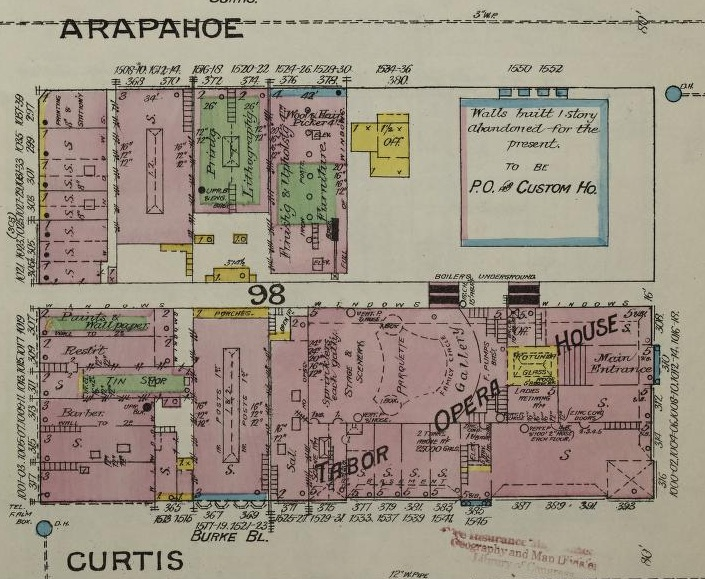
Horace Tabor made his fortune in silver, and in 1881 he decided Denver needed an opera house worthy of the city’s growing prosperity.
The Tabor Grand opened that year at 16th and Curtis Streets, and opening night newspapers described it as “perfection.”
More than $800,000 went into the building, an enormous sum for the time which is equivalent to roughly $18–20 million today. Tabor brought in Chicago architects Frank and Willoughby Edbrooke to design it (Frank Edbrooke would later design Denver’s Brown Palace Hotel).
It was designed in the Second Empire style with a corner tower, and “red brick and white Manitou limestone alternated to create a striking multi-color effect” (CVL).
The interior of the opera house was also designed to show that no expense had been spared. A rotunda glistened with color, and painted brick and white marble steps led up to a main auditorium that seated 1,550 beneath a grand glass chandelier.
The lobby contained a ceiling dome painted in the warm reds and oranges of a sunset. Cherry and mahogany woodwork, stained-glass windows, and silk plush chairs, tapestry and carpets ordered from Marshall Field in Chicago filled the building’s offices and other interior spaces which included a saloon and a barbershop.
On opening night, Tabor presented his theater staff with gold watch fobs and set ticket prices high to attract Denver’s social elite, who arrived in their finest evening attire. The famed soprano Emma Abbott performed for the distinguished crowd that filled the house.
But the Tabor Grand wouldn’t remain at the center of Denver’s cultural life for long. The financial Crash of 1893 devastated Tabor’s silver fortune along with much of Colorado’s economy, and he lost the opera house to mounting debts.
In 1896, the Tabor Grand pivoted to showing motion pictures. The building continued operating as a movie house until 1921–22, when new owners hired Denver architects Fisher & Fisher to extensively remodel the interior and reopened it as the Colorado Theatre with seating expanded to 2,526. At the time it was the largest movie theater in the Rocky Mountain region (Cinema Treasures).
The Tabor Grand survived until 1963, when developers purchased the site for $634,000, less than it had cost to build eight decades earlier.
The theater was demolished to make way for a new home for the Federal Reserve Bank of Kansas City’s Denver branch.
The building’s ornate painted curtain, removed during an earlier renovation, had been placed in storage, where it slowly disintegrated and was eventually hauled to a dump.
A poem that appeared in the Denver press at the time of the demolition proved prophetic: “So fleet the works of men, back to the earth again, ancient and holy things fade like a dream” (Zimmer).
Today, the Federal Reserve building holds the same corner, but there’s no trace of Horace Tabor’s grand ambition.
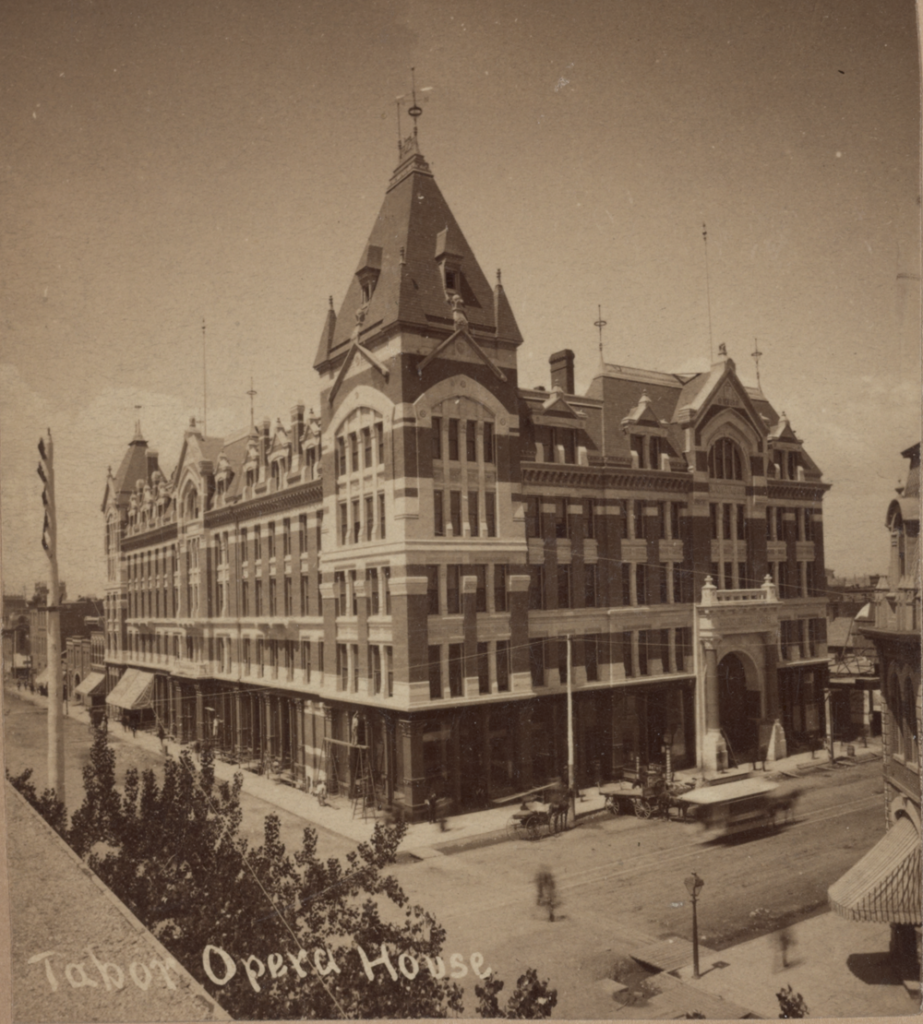
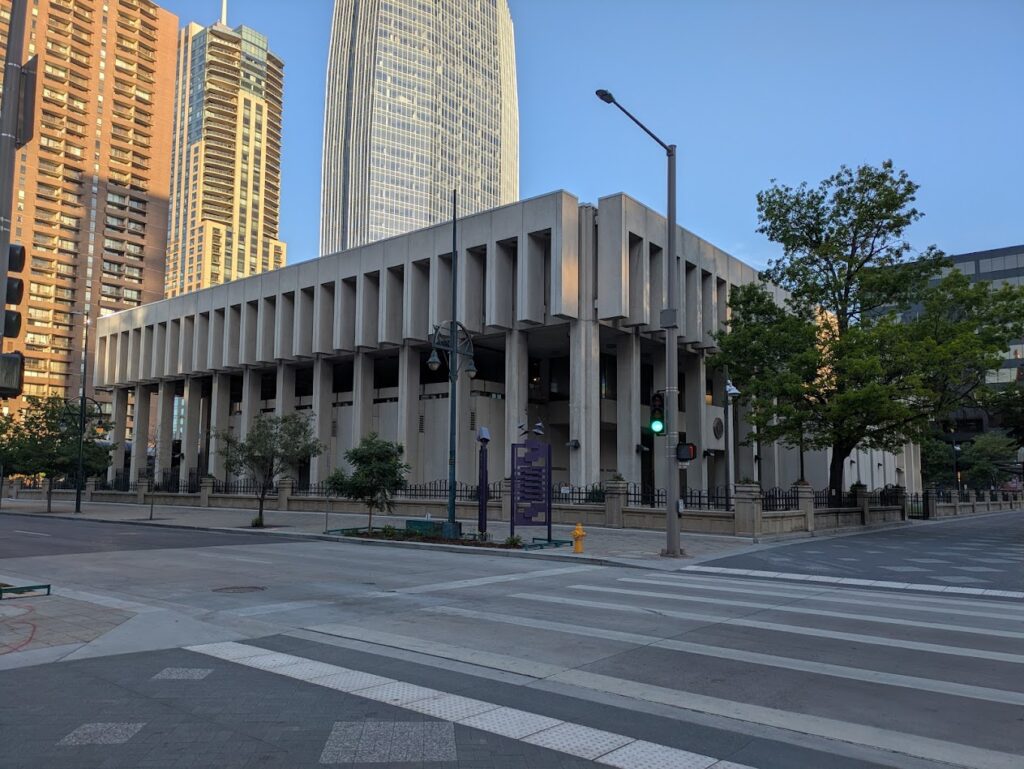
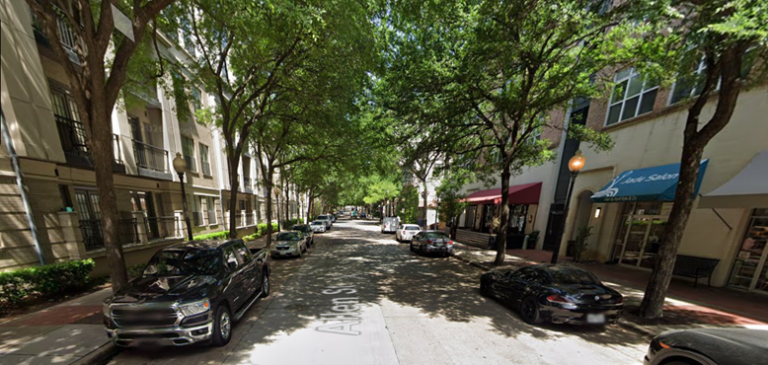
Editor’s note: I took the contemporary image while visiting Denver in June 2026. I thought the modern building was interesting even before learning about the incredible structure that had preceded it.
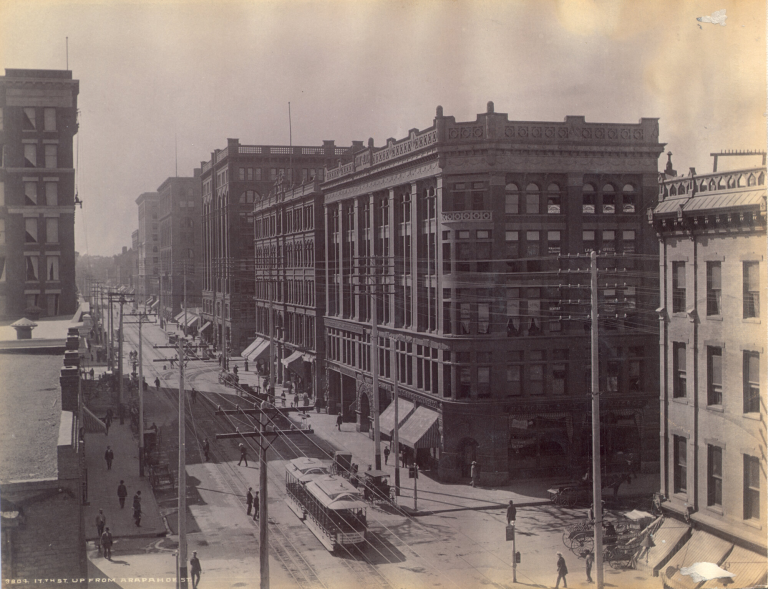
The pedestrianized 16th Street was a great place for a stroll and an interesting mix of old and new architecture, which I learned was due to the specifics of the large downtown urban renewal zone.
For this specific history I was fascinated to learn about the Tabor Grand in the book Lost Denver, which was actually sitting on the desk of my hotel room when I arrived (the Hyatt Regency just a block or so from 16th). The book had a lot of other really interesting lost Denver buildings too:
Sources:
- Zimmer, Amy. Lost Denver. Pavilion Books, 2016.
- Colorado Encyclopedia, “Tabor Grand Opera House” — https://coloradoencyclopedia.org/article/tabor-grand-opera-house
- Colorado Virtual Library, “Time Machine Tuesday: The Tabor Grand Opera House” https://www.coloradovirtuallibrary.org/resource-sharing/state-pubs-blog/time-machine-tuesday-the-tabor-grand-opera-house/
- Cinema Treasures, https://cinematreasures.org/theaters/19055
- Drypigment, “Travels of a Scenic Artist and Scholar” — https://drypigment.net/2020/02/16/travels-of-a-scenic-artist-and-scholar-denvers-tabor-grand-opera-house-and-scenic-artists-robert-hopkins-1881/
- Sanborn Fire Insurance Maps, Denver
- Opera house image, https://www.loc.gov/item/2018647154/