Why It’s Called Miracle Mile: The Empty Fields A.W. Ross Turned Into LA’s First Linear Downtown
I recently read a great book by David Ulin, former book editor of the Los Angeles Times whose accolades include a California Book Award and a Guggenheim Fellowship.
In Sidewalking: Coming to Terms with Los Angeles, he tackles the city’s unique history and urbanism in a way that really spoke to me, musing on the experience of urban walking in a sprawling, auto-centric metropolis and negotiating meaning among the city’s fabric where a closer look reveals traces of multiple eras and a more nuanced story than one might assume.
He weaves in extensive personal experience and literary references. And one section I found particularly interesting was about the stretch of Wilshire known as Miracle Mile, “a name coined, with typical boosterish hubris, in the 1920s by developer A. W. Ross. (Architectural critic Reyner) Banham calls it ‘the first real monument of the Motor Age,’ a western commercial hub built to compete with downtown” (Ulin 43).
I was interested in seeing and understanding the evolution of this area more clearly, so let’s begin with an old aerial showing a much different scene.
Airfields and Oil Wells at Wilshire and Fairfax
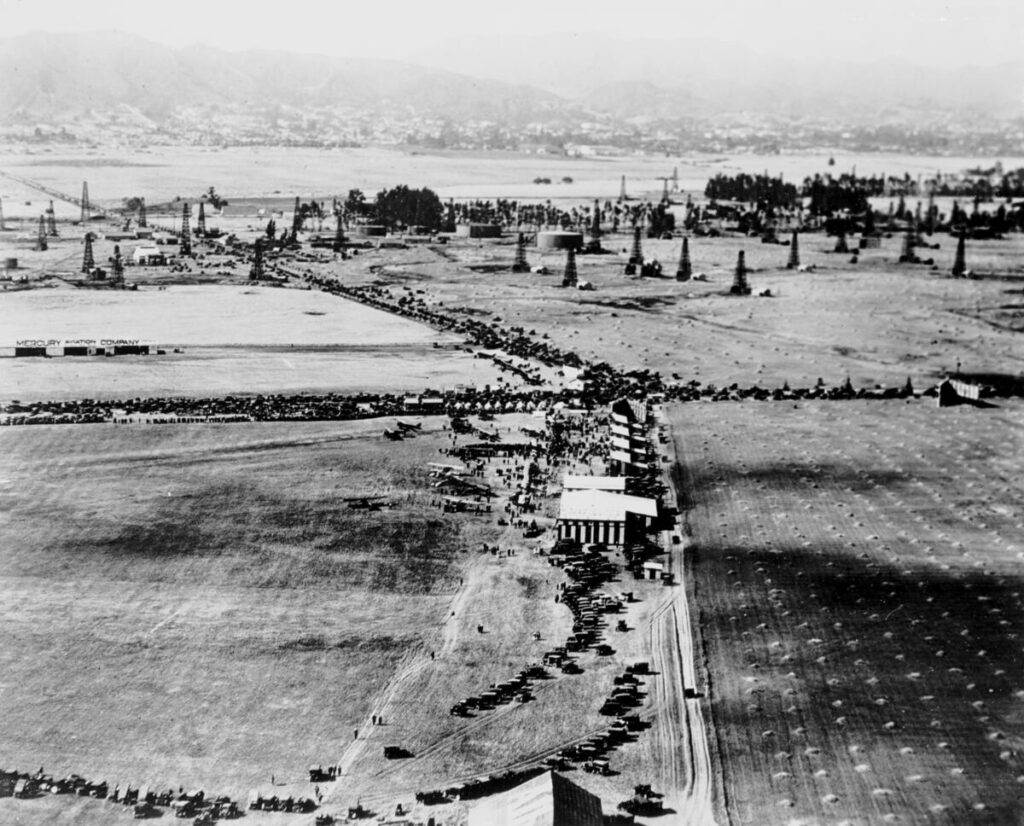
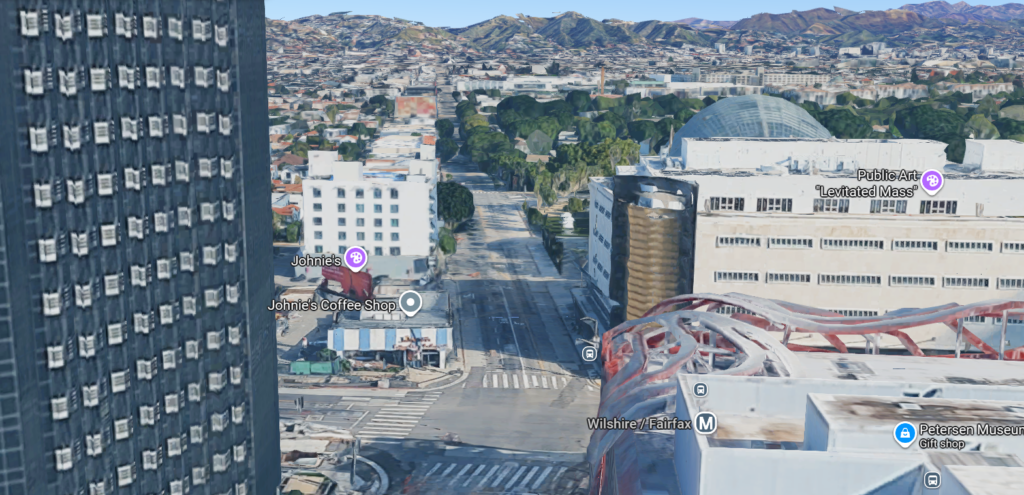
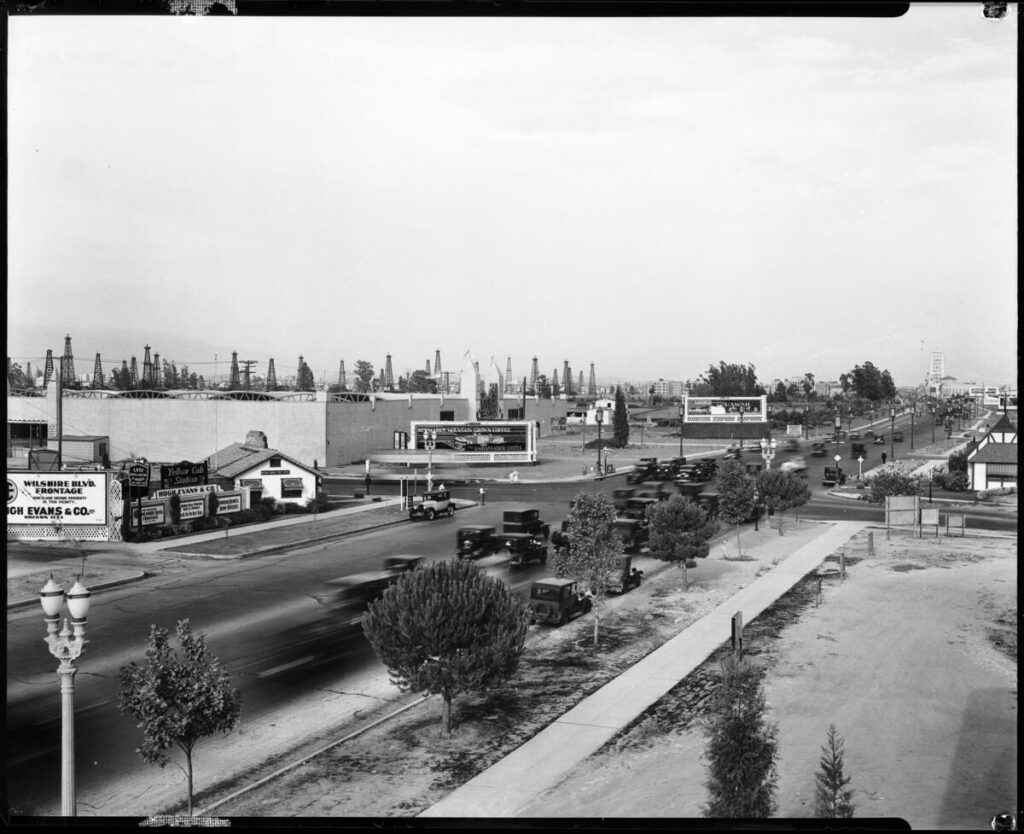
As recently as the early 1920s, the stretch of Wilshire Boulevard now known as Miracle Mile was essentially empty.
Where the Petersen Automotive Museum and LACMA now stand, two small airfields once faced each other across the street, one owned by film director Cecil B. DeMille, the other by Syd Chaplin, Charlie Chaplin’s older brother and a Hollywood producer in his own right.
East of Wilshire one would find oil derricks dotting the ground that would later become the museum’s site.
A.W. Ross and the First Linear Downtown
It wouldn’t stay so empty for much longer. Developer A.W. Ross had already identified the area’s commercial potential, betting that the growing, car-owning populations of Beverly Hills, western Hollywood, and the soon-to-exist neighborhoods of Westwood and Holmby Hills would need somewhere to shop closer than downtown Los Angeles.
Ross first called his development the Wilshire Boulevard Center, a name few people ever used. The Miracle Mile name didn’t arrive until 1928, when a friend, listening to Ross describe his vision for the strip with typical enthusiasm, remarked that from the way he talked, you’d think this was really a miracle mile. Ross recognized good promotion when he heard it, and the name stuck.
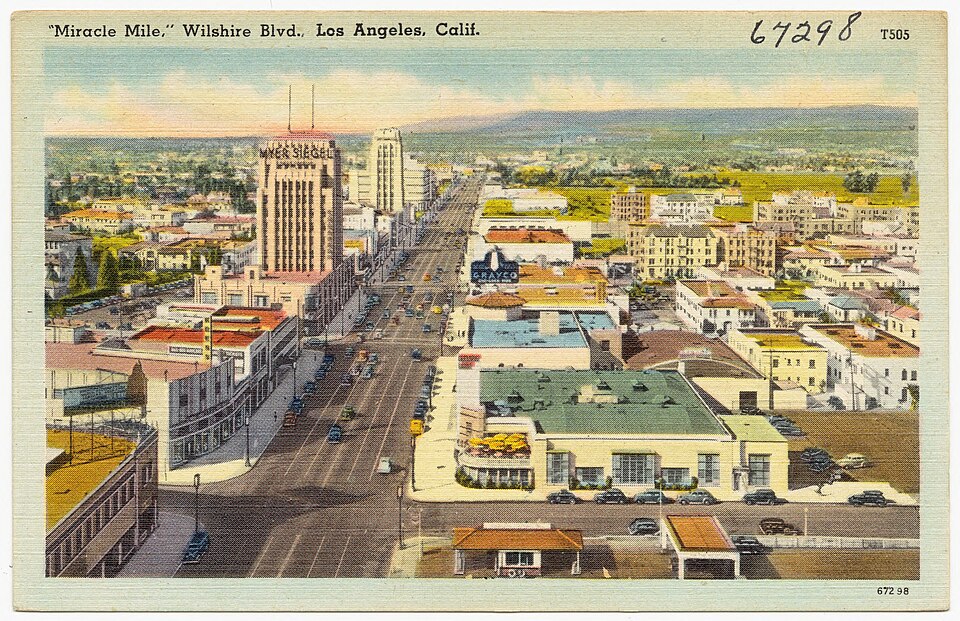
Ross bought up the land through the 1920s, and one can see Banham’s point about it being the first monument of the Motor Age in the design of the commercial strip aimed at supplanting the dominance of downtown through automobile access rather than serving a walkable neighborhood.
Its shops faced the sidewalk in the manner of a conventional downtown street, but each one had its own parking lot behind it, a design compromise between traditional urban shopping and the emerging demands of a car-owning public.
Within a decade of Ross’s first purchases, Miracle Mile had become one of the country’s earliest examples of retail built explicitly around automobile access rather than foot traffic or streetcar lines.
Miracle Mile Today: How It Became Museum Row
Ross’s retail strip didn’t stay dominant forever. By the 1960s and ’70s, competition from newer shopping centers pulled business away from Wilshire Boulevard, and several of Miracle Mile’s original department stores closed or relocated.
What revived the district wasn’t more retail, but rather museums.
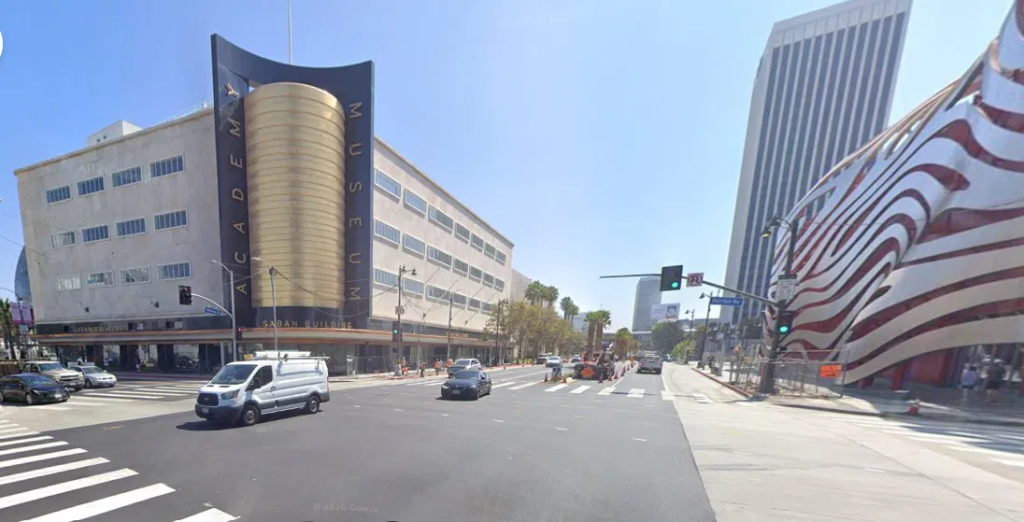
The Los Angeles County Museum of Art (LACMA) had already moved to the area in 1965, and further anchors followed over the decades: the long-vacant Orbach’s department store reopened in 1994 as the Petersen Automotive Museum, and the historic 1939 May Company building, once one of the strip’s grandest stores, became LACMA West in 1998. It would reopen again in 2021 as the Academy Museum of Motion Pictures, home of the Oscars.
Today, that same stretch of Wilshire is known locally as Museum Row, anchored by LACMA, the Petersen, the Academy Museum, Craft Contemporary, and the La Brea Tar Pits and Museum, where tar still bubbles up from the same ground A.W. Ross once eyed as an unlikely site for a shopping district.
The airfields and oil derricks are long gone, but the land itself never stopped drawing crowds, only the reason changed.
Sources:
- David Ulin, Sidewalking: Coming to Terms with Los Angeles (2015)
- Reyner Banham, Los Angeles: The Architecture of Four Ecologies (1971)
- PBS SoCal, “How the Miracle Mile Got Its Name: A Brief History of L.A.’s Unlikely Retail District”