The Larimer Square Historic District: How Dana Crawford Saved Denver’s Original Main Street
A massive urban renewal project beginning in 1969 cleared an area of about 120 acres of Downtown Denver. Only a couple of historic landmarks in that section of lower downtown were spared.
One was the Daniels & Fisher Tower, while the other was a single block of Larimer Street. That block was Denver’s original Main Street, later became a skid row, and after being saved went on to become the city’s first historic district.
History of Larimer Street, Denver’s Original Main Street
Long before it became a dining and nightlife destination, Larimer Street was the center of commerce for the newly-formed settlement.
In 1858, William H. Larimer Jr. founded Denver City across Cherry Creek from the town of Auraria and named the main street after himself. He built himself a cabin close to what is today Larimer and Fifteenth Streets.
Larimer Street survived the fire of April 1863, and in the 1860s it was home to the Rocky Mountain News, the precursor of the Daniels & Fisher department store, the post office, and the county jail.
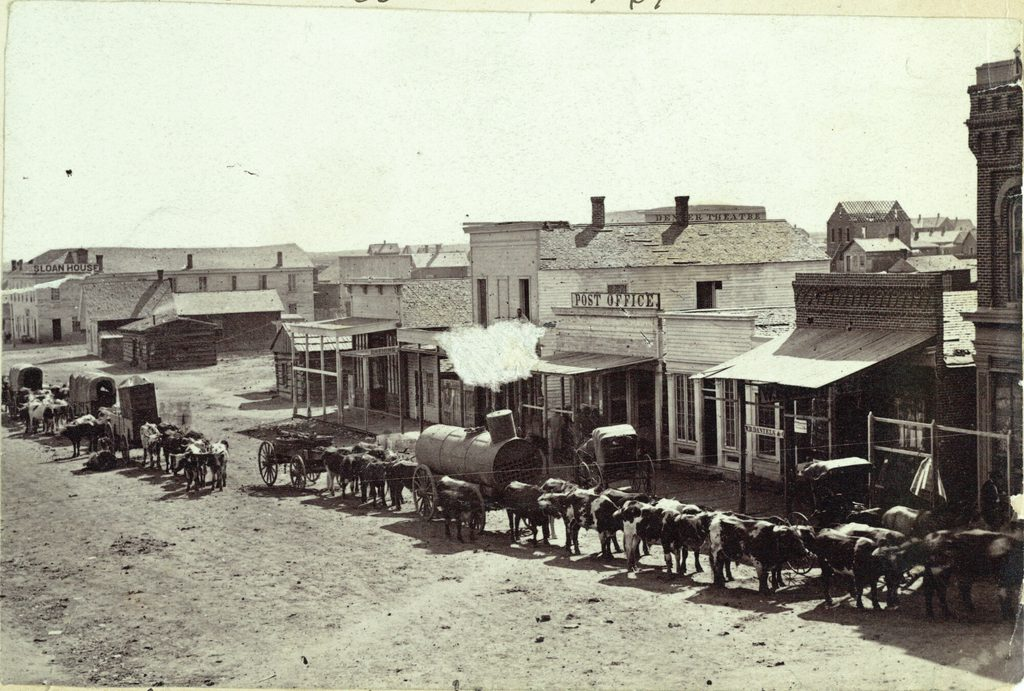
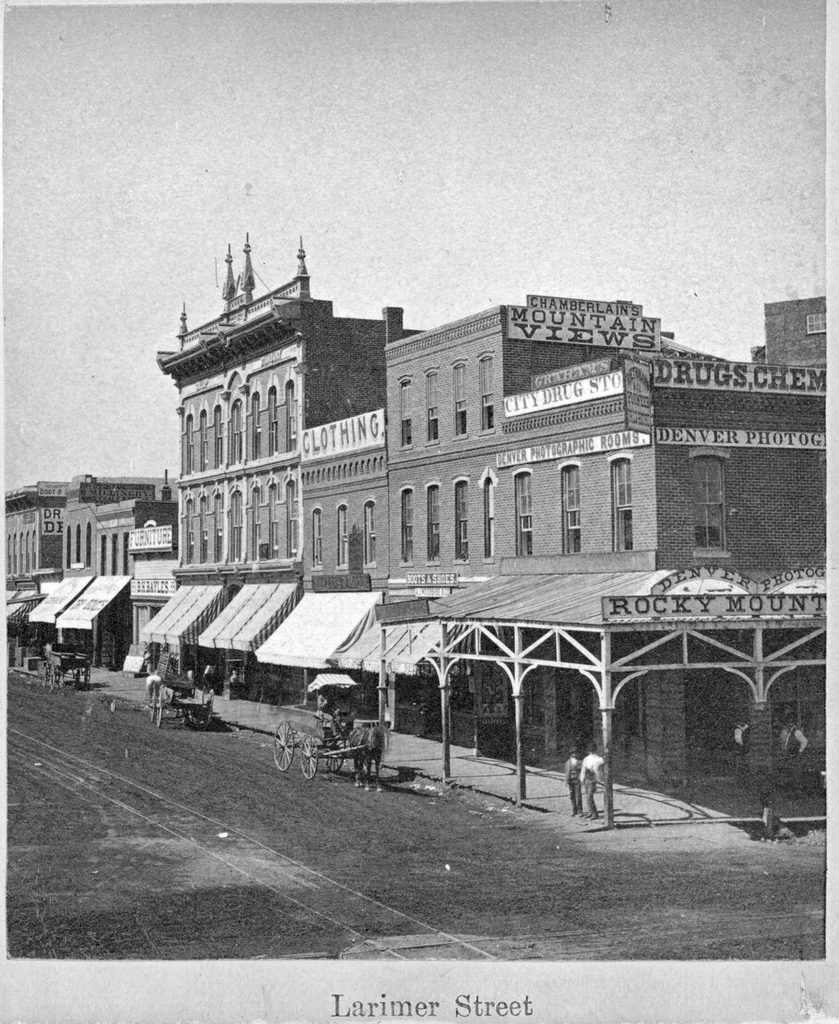
Construction boomed in the 1870s, as the city’s first streetcar line arrived in 1871, and rail connections and money from nearby mines brought a wide variety of the city’s finest businesses to Larimer Street.
Most of the surviving buildings are multistory brick commercial buildings from the 1870s and 1880s. The oldest is the Kettle Building, built in 1873 at 1426 Larimer, originally home to a butcher shop.
Lincoln Hall (1887), a Second Empire building at 1413-1419 Larimer, housed a dance hall and later a harness shop.
In 1882, brothers George Washington Clayton and William Clayton built a four-story building at the corner of Fifteenth Street on the site of William Larimer’s original cabin. It served as McNamara Dry Goods and later the Granite Hotel.
Gahan’s Saloon (1889) at the other end of the block served politicians from the city hall that opened in 1883 at Larimer Street and Cherry Creek.
How Larimer Street Became Denver’s Skid Row
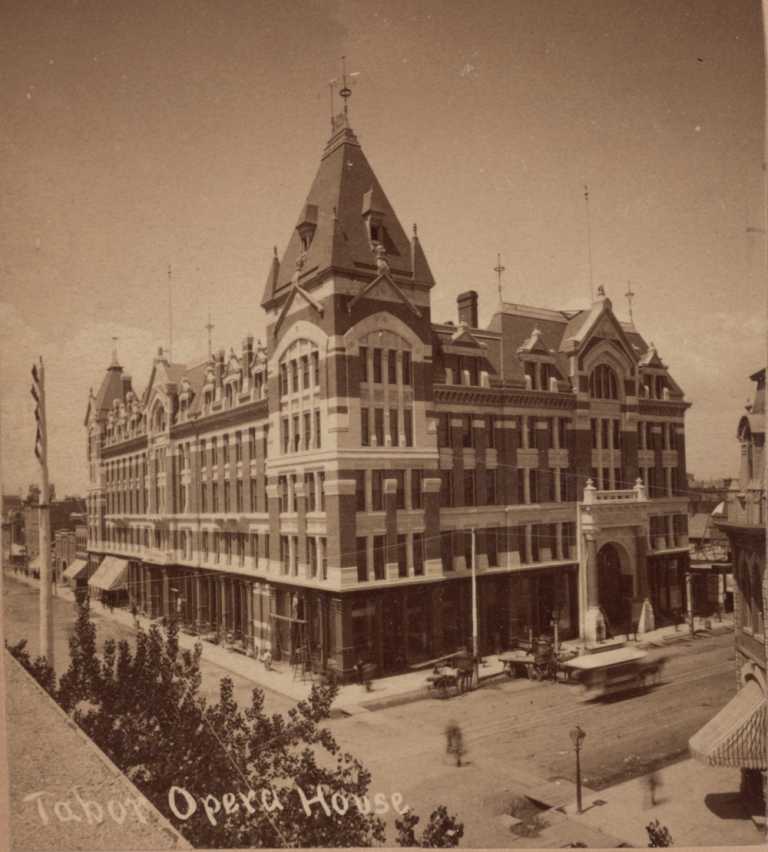
In 1880, Horace Tabor’s Tabor Block opened at Larimer and Sixteenth Streets facing Sixteenth rather than Larimer, and the Tabor Grand Opera House followed in 1881. Tabor and his associates turned Sixteenth Street into the city’s major shopping and entertainment street.
Seventeenth Street became the center of Denver’s banking and finance and also a larger concentration of hotels during those same years..
After the Panic of 1893, Larimer Street’s status nosedived: no new buildings went up for decades, and by the early 20th century it was developing a reputation as Denver’s skid row.
A 1926 effort by business owners to rename the street “Main Street” went nowhere. In the early 1930s, the city government moved to the new City and County Building at Civic Center.
By the middle of the century, the dozen blocks of Larimer Street from 11th to 23rd contained 46 bars and liquor stores, 57 flophouses, 17 pawn shops, 22 secondhand stores, and 10 missions.
Dana Crawford and the Skyline Urban Renewal Project
In 1958, the newly-formed Denver Urban Renewal Authority (DURA) announced the Skyline Urban Renewal Project, which called for demolishing roughly 30 blocks from Speer Avenue to 20th Street between Curtis and Larimer Streets.
Voters rejected it in 1964 but would approve it in 1967 after DURA obtained federal funds.
The 1400 block sat inside that footprint, and it would likely have been demolished with the rest if not for Dana Crawford.
After reading about Gaslight Square, an entertainment district in St. Louis, Crawford decided in 1963 to create something similar on Larimer Street.
She formed Larimer Square Associates, an investor group that bought the block’s buildings one at a time to restore them for new uses.
The buildings were gutted and stripped of the modernizations they had accumulated over seven decades, given new wiring, plumbing, heating, and interiors, and architect Langdon Morris Jr. designed courtyards and arcades to open up the block. The restored Larimer Square opened in 1965.
The Larimer Square Historic District: Close Calls and Today’s Entertainment District
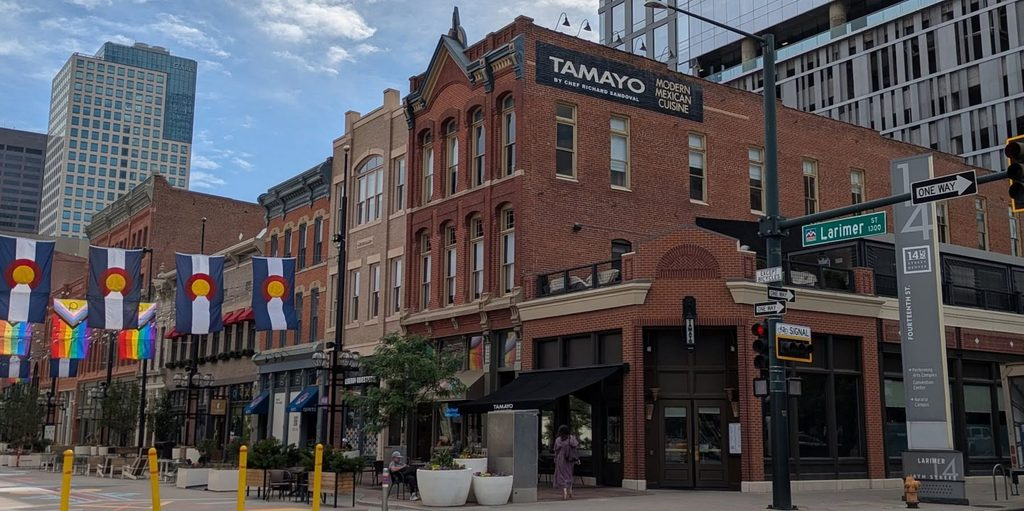
Saving Larimer Square’s buildings was just the first step, as their continued upkeep has taken a good deal of work as well.
Larimer Square became Denver’s first historic district in 1971 and was listed on the National Register of Historic Places in 1973. The district, after being expanded in 1994, includes 22 buildings, and its designation was the first in Denver to recognize a collection of related buildings and their context rather than individual landmarks.
Its success helped spur similar projects in Lower Downtown and at Union Station, and the Lower Downtown Historic District followed in 1988.
Dana Crawford sold Larimer Square in 1986, and Jeff Hermanson bought it in 1993. New buildings were added in the 1990s where parking lots had stood.
In 2018, Hermanson and his partners at Urban Villages floated a plan to seek amendments to the historic district’s protections so they could exceed its height limits with two towers, one up to 40 stories, and partially demolish several historic buildings.
The announcement put Larimer Square on the National Trust for Historic Preservation’s 11 Most Endangered Places list, but the plan never progressed.
Then in December 2020, Asana Partners, a Charlotte, North Carolina real estate investment firm, bought the block for roughly $92 million.
Asana invested about $20 million in restoring 18 buildings over three years, including over 300 windows with extensive wood rot and 21 tons of stone and masonry repairs.
Historic Denver’s 2026 project honorees write-up even says that several facades were nearing collapse.
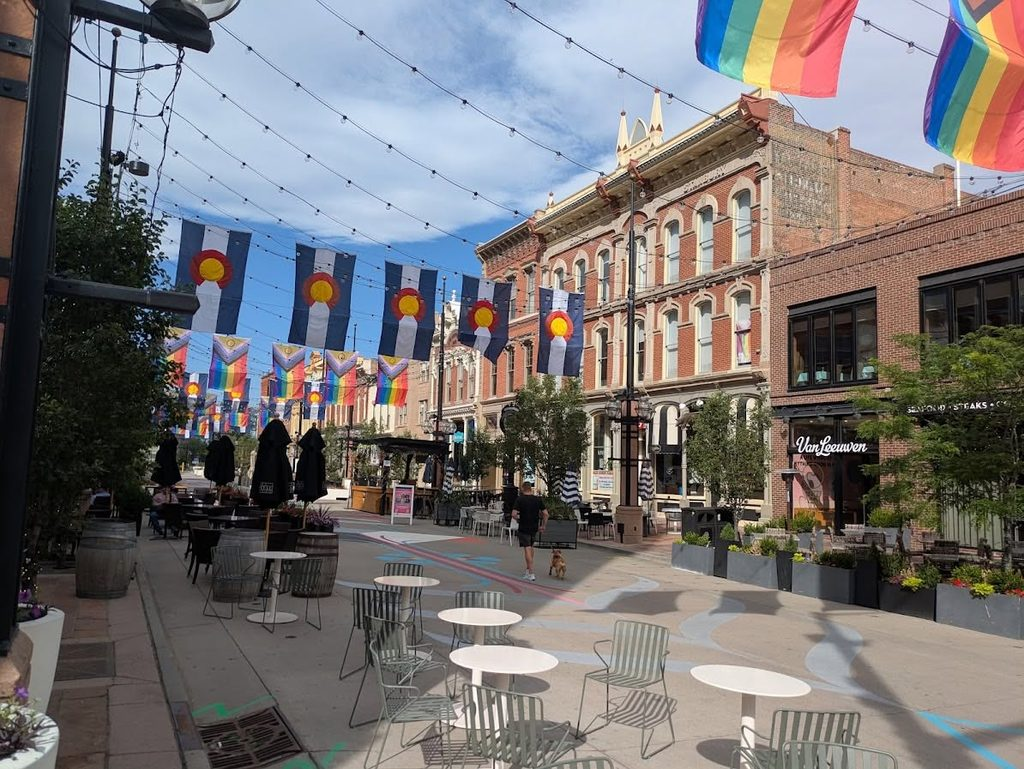
Today, Larimer Square is a pedestrian-friendly shopping and dining destination: more than 30 restaurants, bars, shops, and galleries fill the restored 19th century storefronts, with a focus on locally owned businesses over national chains. It’s just the kind of entertainment district that was originally imagined by Crawford in the 1960s.
Sources
“Larimer Square,” Colorado Encyclopedia, https://coloradoencyclopedia.org/article/larimer-square
“Larimer Square: Iconic Block Has New Owners,” Historic Denver, https://historicdenver.org/larimer-square/
“Larimer Square in Denver sold to North Carolina real estate firm,” 9NEWS, https://www.9news.com/article/money/markets/real-estate/larimer-square-sold-to-north-carolina-real-estate-firm/73-883c814a-cd4c-42f2-baad-e1db4414db05
“More than 3-year-long Larimer Square restoration project nears completion,” Denver7, https://www.denver7.com/news/front-range/denver/4-year-larimer-square-restoration-project-nears-completion
“Historic Denver Announces 2026 Project Honorees,” Mile High CRE, https://milehighcre.com/historic-denver-announces-2026-project-honorees/